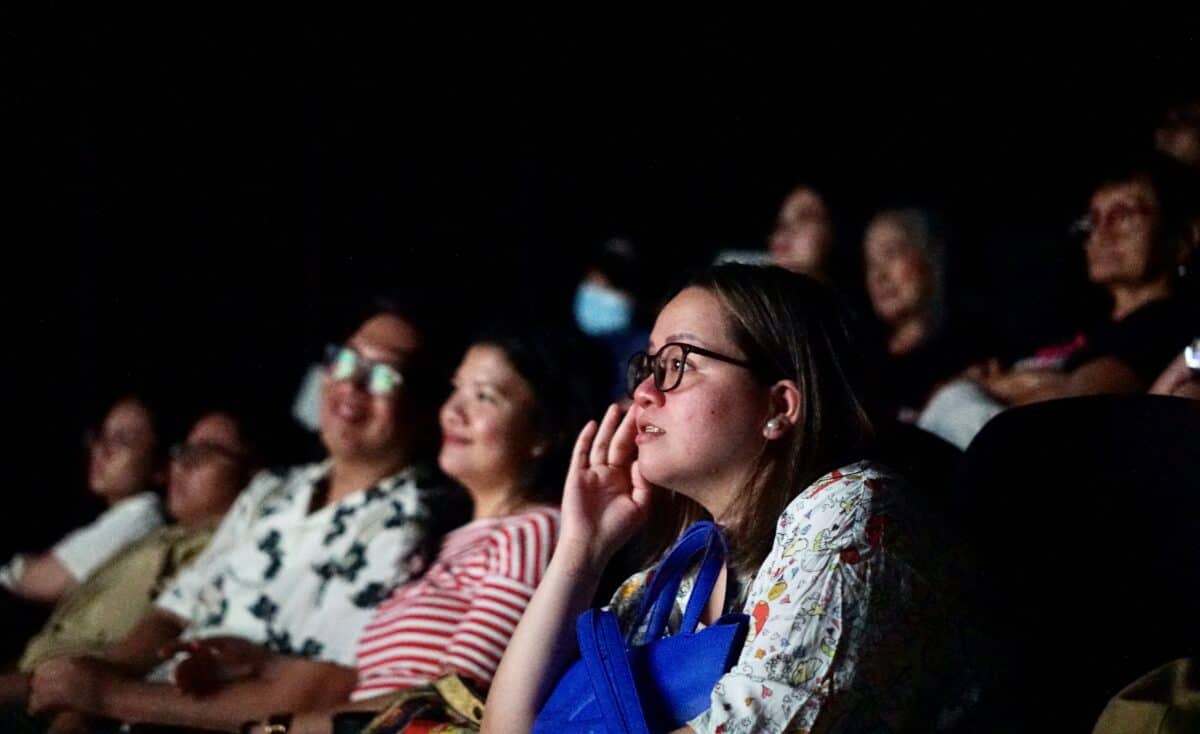
Last May 23, the Filipino Documentary Society (FilDocs) held a screening for the Academy Award-nominated documentary “Come See Me in the Good Light” by Ryan White. Held at Sine Pop, the event gathered filmmakers, film enthusiasts, and members of the ICanServe Foundation Philippines—a Philippine-based advocacy group of breast cancer survivors and volunteers.
The documentary itself is about American poet and activist Andrea Gibson and their fight with cancer.
READ: ‘Remain profoundly human:’ Pope Leo XIV’s first encyclical on AI

Moving as it is emotional
The film interweaves the story of Gibson’s youth, their early struggle with their identity and sexuality, their career as a spoken word poet, and the love story of Gibson and Megan Falley, which serves as the emotional core of the documentary.
White and his team have incredible access to Gibson, who is as articulate as they are introspective. Gibson is honest and candid about their feelings and ruminations about their mortality. Falley and Gibson give us a direct line to the love that holds them together as Gibson’s prognosis and battle with cancer go up and down.
It is an emotional piece, where one can be moved by several things: the story of queer love, shared so unabashedly; the struggle with cancer, which is hard for anybody; the precision of Gibson’s poetry, because they do read some of their work as it pertains to the life they are leading.
The words take on a special weight—and of course, I was moved by all of this. As a former practicing poet, a person with an illness, and someone who yearns for the kind of love that Falley and Gibson have, “Come See Me In the Good Light” is powerful stuff.


The impact of documentaries
Broadcast journalist and documentarian Kara Magsanoc-Alikpala, a member of FilDocs, invited me to join the first screening of the documentary and to moderate the talkback session with the audience, many of whom are cancer survivors or people in the middle of their battle with the disease.
It was an emotional viewing. Just 12 minutes into the film, I was already sobbing when Gibson read her first poem. People around me were gasping and choking and holding back tears. I was freaked out about having to moderate the talkback with people who have lived the experience that was being shown on screen.
And I was so deeply in touch with my feelings that I had to compose myself after the film, as I had to lead the discussion.
I opened up about my own struggles with HIV and the multiple complications that it had carried as a means to create a connection—that I, too, understood the struggle in some form or another and that I had had to deal with the thoughts of my mortality the way Andrea Gibson does in the documentary, the same way some audience members have. It was there that we were able to talk about how the film brought up similar experiences with the crowd.
This is what is called impact assessment—an important phase in any documentary. The filmmaker’s job is not finished when the documentary is done and shown in the cinema. The mindful, responsible documentarian must get the film to be seen by the people who need to see it and facilitate a discussion with these stakeholders.
For Ryan White, allowing FilDocs to hold two screenings in the Philippines, with one screening held for the members of the ICanServe Foundation Philippines (and holding a talkback with them), answers part of that call to action.
READ: ‘Remain profoundly human:’ Pope Leo XIV’s first encyclical on AI

Documentaries surging forward
After the screening and the talkback, I talked with Monster Jimenez, documentary filmmaker and another founding member of FilDocs. She shares that this event is part of the Basta Dokyu, a quarterly series where they screen documentaries from all over the world.
In July, they have programmed the Oscar-winning documentary “Mr Nobody Against Putin,” by David Borenstein and Pavel Talankin. “There’s a bit of chasing that has to happen,” Jimenez tells me about acquiring the rights to show the films. “It’s not that hard because Kara [Magsanoc-Alikpala] is an Academy member. She actually gets to see the films before they get nominated.”
And in a way, Magsanoc-Alikpala gets to pre-screen and choose which documentaries they can show. But they still have to get permission from the filmmakers.
Luckily, for “Come See Me in the Good Light,” White and Falley gave the screening rights for free. “Because they are documentaries,” explains Jimenez, “there’s a lot of compassion.” Often, the filmmakers would love to have their films screened to a dedicated audience, and it helps that we are a little archipelago in Southeast Asia—it makes it easier to get permission because it shows how far-reaching the impact of a documentary can be.
But for “Mr Nobody Against Putin,” it’s a little bit more of a challenge. “It’s a big film,” shares Jimenez. “It won the Academy [for Best Documentary Feature], so the screening fee charges are really high.”
When these things happen, the members of FilDocs usually front the licensing fees and try to earn back the cost through donations or grants. They want to avoid charging fees because “the moment it becomes commercial, it affects the way some people see the documentary.”
But it is something that the members of FilDocs—Jimenez, Magsanoc-Alikpala, and Jewel Maranan—should think about. According to Jimenez, these Basta Dokyu series are “always full.” She says, “We only wanted to hold one screening per day. It shouldn’t have to be an effort for Kara and myself. We wanted it to feel casual, but because there’s so much demand, we have to hold two screenings.”
When asked whether distributors and exhibitors should consider distributing and allowing documentaries into mainstream markets, Jimenez said “yes” before I even got to finish my question. She states the problem isn’t the demand—it’s marketing the films to let people know they are available.