For many, the compact disc belonged to another era—a ubiquitous vessel during the ’80s up to the 2000s used for storing music, movies, and also memories. While CDs have generally disappeared into drawers, at West Gallery, the humble CD is spinning once more, now through the hands of printmakers.
Through tactile experimentation and material reuse, the group exhibition features works by Alynnah Macla-Tadeo, Benjie Torrado Cabrera, Diana Aviado, Plet Bolipata, Don Kusuanco, Elmer Borlongan, Jojo Barja, Luigi Azura, Angelo Magno, Mars Bugaoan, Noëll El Farol, Pandy Aviado, Poeleen Alvarez, Soler Santos, Taj Hassan Asinas Tadeo, Anton Villaruel, and William Matawaran.

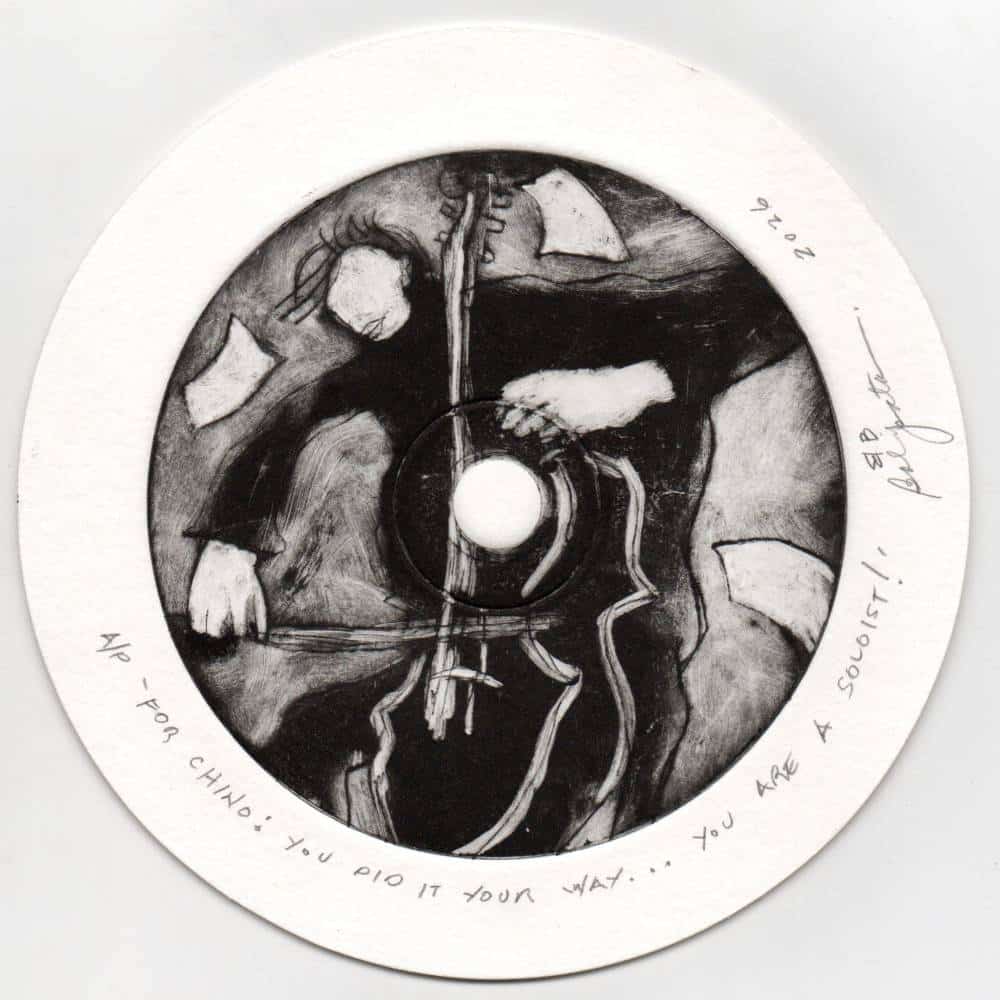
And by transforming these compact discs into striking drypoint prints, these artists demonstrate that yesterday’s technology still has a couple more stories to tell.
Reimagining an obsolete object
Instead of carving into the copper or zinc plates, which are traditionally used in drypoint printmaking, the artists engrave discarded CDs, which are then inked and pressed onto paper to create their prints. It’s ingenious, and it makes you wonder: Who would’ve thunk?
Unlike conventional printmaking plates, CDs come with built-in constraints. Their circular shape and the hole at the center especially required the artists to rethink how the image was composed.
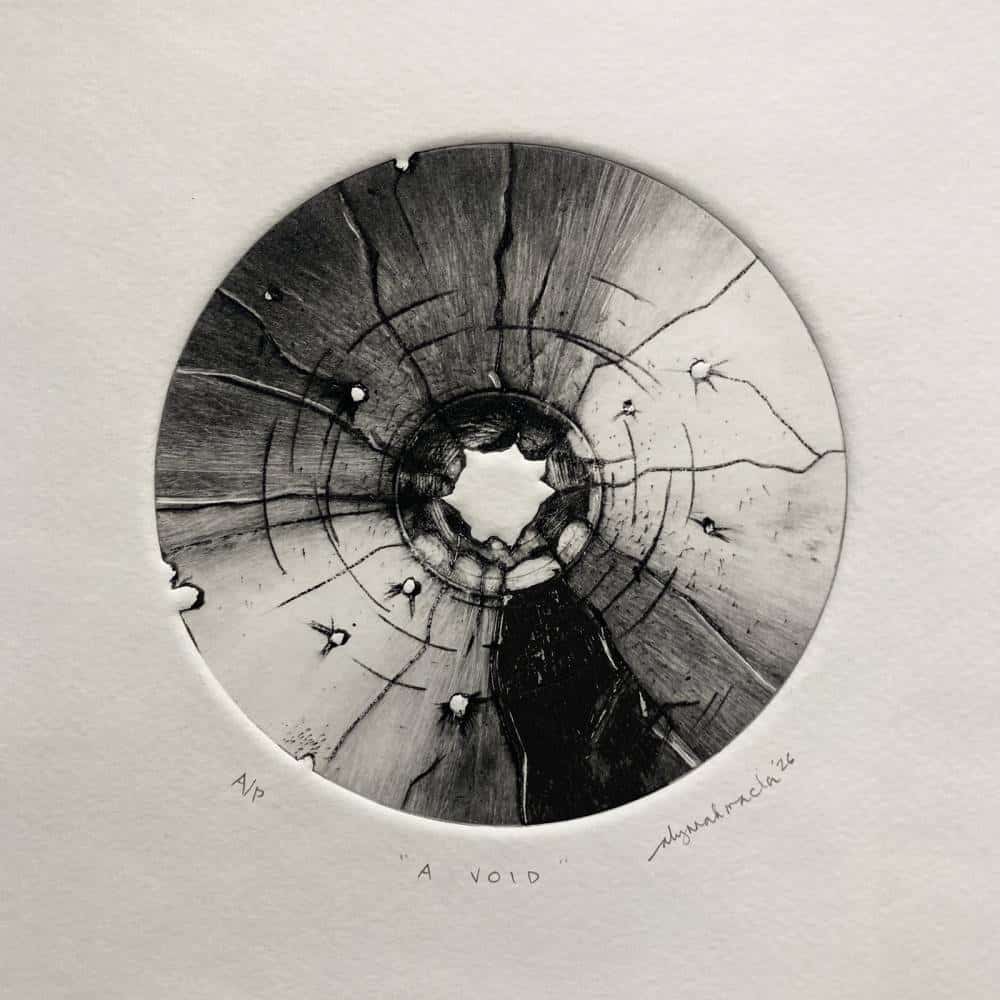
For artist El Farol, the absence at the center became part of the work itself. “The void at the center becomes an integral part of the composition,” he explains, which pushed the artists to rethink where they make a focal point, without a center.
READ: There’s no one way to be a woman
“The void at the center becomes an integral part of the composition”
The material itself behaves differently from metal. Scratching into its surface produces burrs and textures that soften the precision of the original digital grooves. El Farol describes the process as “a dialogue between ephemeral data and the tactile permanence created by drypoint,” highlighting how a digital information carrier can have a lasting physical imprint.
Memory in the material
For Magno, the CD holds cultural memory. “When Sir Borlongan suggested using CDs as a matrix, it was an exciting challenge,” he says. “The CD was an iconic relic from the ’90s. It defined the music and film industry during those times.”
“Having a CD player meant being ‘hi-tech’ during the ’90s. It was a sign of progress… It would be a good material to play with the idea of memory, recall, reminiscing, and similar themes.”


This history was translated into his prints, such as “Recuerdos de Mi Vida (Objects of my life),” an assortment of objects from plants and relics, which he associates with spirituality, gender, and lifestyle. For “Othering,” he played with a broken CD to create multiple faces on the surfaces.
Possibility in constraint
The exhibition also underscores the creative potential of reuse. Rather than treating outdated technology as waste, the artists embrace it as an alternative printmaking surface.
For Alvarez, working with CDs meant surrendering preconceived notions about the medium. Her first attempt relied on delicate hatching, similar to the acrylic plates she usually works with. But the CD refused to cooperate. After repeated revisions, the matrix broke in half! “I was quickly humbled by the material,” she recalls.
“I was quickly humbled by the material”

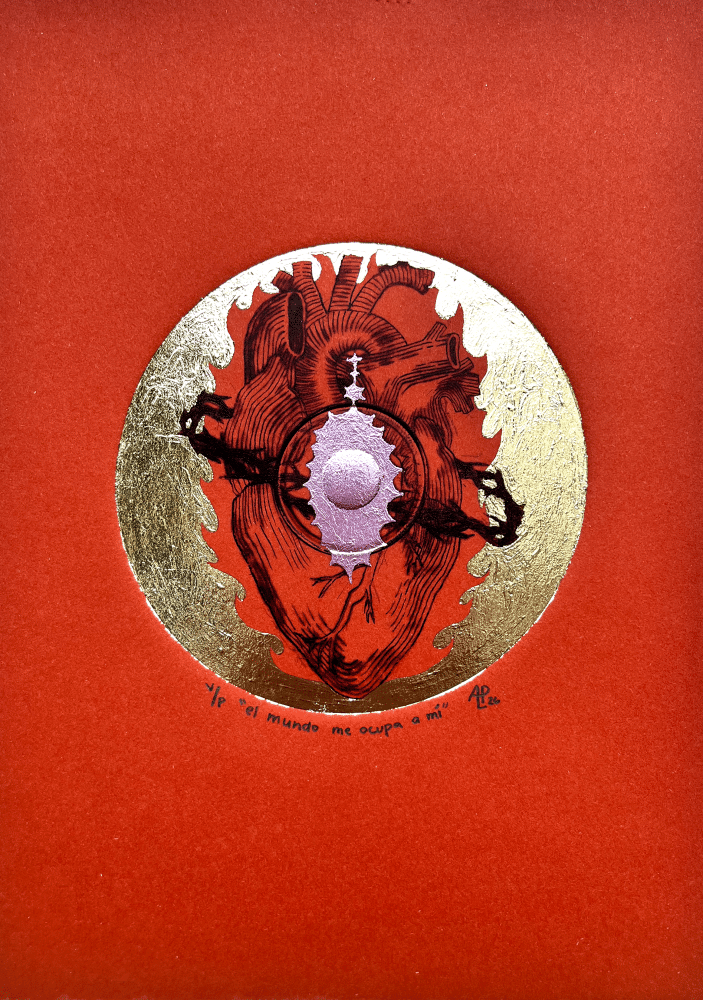
Starting over, Alvarez abandoned intricate detail for bolder, graphic lines, looking to old anatomical illustrations and medieval-age illuminated manuscripts for inspiration. “The constraints of the medium forced me to redirect my vision,” she says. “A happy accident, considering that I arrived at a composition that I think portrays my current disposition better than the first composition did.”
Her finished piece, “el mundo me ocupa a mí (‘the world occupies me’),” transforms the CD’s central hole into the Cosmic Egg, “a mythological motif in many cosmogonies across various cultures that represents the beginning from which the world emerged.”
READ: The Museo del Galeón is ‘ciertamente’ worth the voyage
The lasting appeal of print
In many ways, “Disc.cussion” doesn’t just give discarded CDs a second life. It reaffirms the relevance of printmaking itself, especially at a time when digital tools have become the norm. This show celebrates slower, more hands-on processes that leave behind the tangible record of the artist’s touch.“There is an intimacy in creating prints… It is almost ritualistic and meditative,” El Farol observes. Meanwhile, Alvarez shares, “When I am in the studio printing, I feel so incredibly aligned and in tune with myself.”

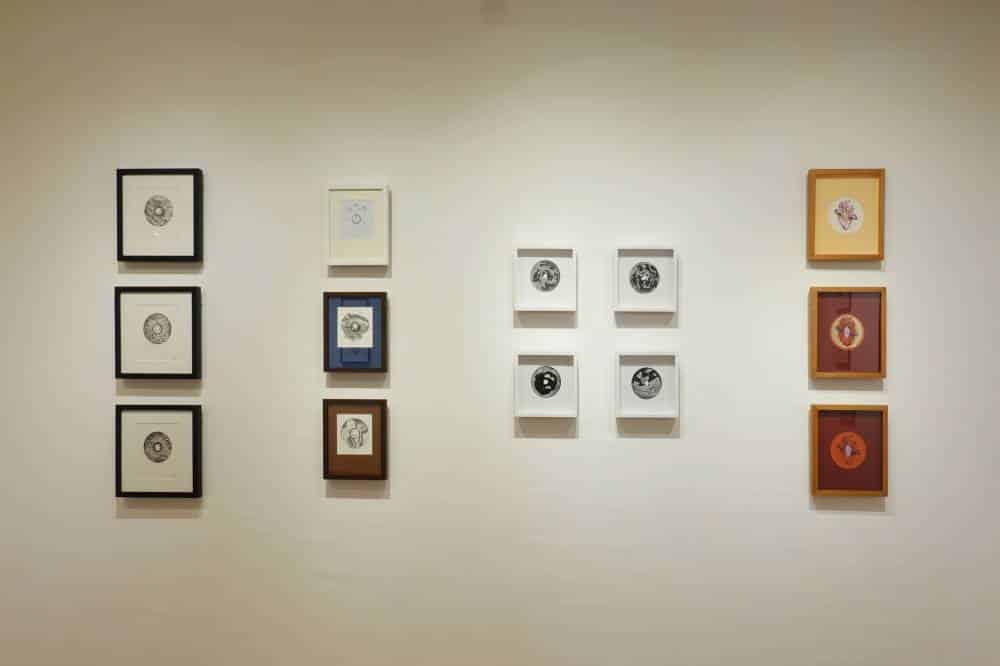
“There is an intimacy in creating prints… It is almost ritualistic and meditative,” Magno reflects.
“There is an intimacy in creating prints… It is almost ritualistic and meditative”
As the CDs become both medium and message, the show points out that innovation doesn’t always require new technology. Sometimes it could just be by looking at familiar objects under a different light.
“Disc.cussion” runs until July 18 at West Gallery, 48 West Avenue, Quezon City.