The Philippine Roman Catholic Church’s cultural patrimony is shielded from the controversial National Cultural Heritage Act of 2009 (Republic Act 10066) because of the constitutional principle of separation of Church and state; the Church’s own canon law; and the Concordat between the Holy See and the Philippine government on Church cultural heritage.
“While the Church unites with the state in the national policy to protect, preserve and promote the nation’s cultural heritage, the law should not prohibit and penalize necessary works on churches,” said Jo Imbong, a lawyer of the Catholic Bishops Conference of the Philippines (CBCP).
Examples of “necessary works” are the construction of chapels and additions to the church rectory or other facilities that are inherently necessary to worship and liturgy.
Imbong was speaking in a forum on the National Cultural Heritage Law at the Angelicum College in Quezon City, with National Commission for Culture and the Arts (NCCA) Commissioner Regalado Trota Jose and former NCCA commissioner Fr. Harold Rentoria, OSA.
Theme was “Kaban ng Nakaraan, Yaman ng Kasaysayan: RA 10066: National Cultural Heritage Act of 2009.” It was held on Aug. 8, feast day of St. Dominic, the founder of the Dominicans, which own and run the Angelicum.
The lawyer said the Church was an autonomous institution, whose physical works and maintenance of properties were guided by canon law, or Church law.
The autonomy of the Church in administering its properties “is in keeping with the free exercise clause [of religion]:” “The free exercise and enjoyment of religious profession and worship, without discrimination or preference, shall forever be allowed (Art. III, Sec. 5, Constitution).”
The autonomous status of the Church, with its system of law and legal rights, is acknowledged in the Constitution with the provision “The separation of the Church and State shall be inviolable (Art. II, Sec. 6).”
Alarming
The National Cultural Heritage Law, whose guidelines have yet to be drawn, has alarmed many sectors for what its critics say are its all-encompassing provisions that empower the state to virtually expropriate structures (at least 50 years old, the law says), artworks and other cultural artifacts.
The law lists three major prohibitions: relocating, rebuilding, defacing, or undertaking any change that could destroy the authenticity of the cultural treasures (Sec. 20); destruction, demolition, mutilation, or causing damage to the heritage (Sec. 48a); and altering the original features of historic edifices without appropriate permission from the National Historical Institute.
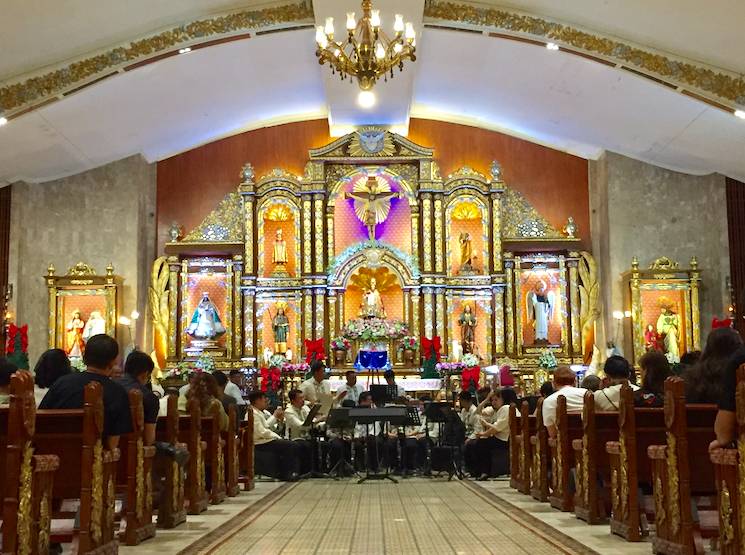
It should be noted that the Church owns a significant number of important historical landmarks and cultural artifacts, especially churches and art works.
In fact, in January 2002, the CBCP and NCCA signed a memorandum of agreement for the protection of 29 old churches and other religious sites, on top of Church properties that are already listed on the World Heritage List of the United Nations Educational Scientific Cultural Organization (Unesco).
Moreover, the Concordat signed in 2008 by Pope Benedict XVI and President Gloria Macapagal Arroyo stresses the importance of the Church’s cultural patrimony to national heritage.
Juridical authority
Imbong said the accords should show that the state recognized the Church’s “juridical identity” over the latter’s properties.
“To a Christian people like us, whose spirituality is steeped in faith, history and pious tradition, Philippine churches, whether colonial or modern, embody the national soul,” said Imbong.
She explained that Church structures, including the religious art therein, such as religious icons, constituted “Church culture,” which, in the laws of the state, was a treasured part of culture of both the Church and the nation.
To be sure, the responsibility of the Church to preserve and protect its heritage can be better addressed by understanding the juridical status of the Church.
She explained the Church “has a distinct system of law that treats ecclesiastical matters and persons. It has “legal rights, [especially] the right to own and administer property,” and that “it is sovereign and supreme within its own ecclesiastical sphere.”
Since the Constitution recognizes religious freedom, it also recognizes the Church in the Philippines owns, “for ecclesiastical purposes,” properties, like land lots, structures, and the necessary accessories.
But the administration of these properties are subject to the “formal or technical norms of ownership,” which are stated in the laws of the state, Imbong said.
Prohibiting religious attacks
RA 10066 identifies cultural property as “all products of human activity by which a people and a nation reveal their identity, including churches, mosques, and other places of worship, schools and natural-history specimens and sites, whether public or privately owned, movable or immovable, and tangible or intangible.”
Because of the broad coverage of the law, many groups are suggesting limitations or explications on the proposed guidelines to govern its implementation.
Because of the furor recently over the Cultural Center of the Philippines, a state agency, mounting “Polytheism,” an installation work by Mideo Cruz showing the cross with an erect phallus and Catholic images dotted with condoms, Imbong said the CBCP had proposed to include among the prohibitions “any act that defiles, mocks, corrupts, debases or destroys the integrity of intangible cultural property or heritage.”
“Intangible cultural heritage” covers “oral traditions and expressions; the performing arts; social practices, rituals, and festivities; knowledge and practices concerning nature and the universe; and traditional craftsmanship.”
Acts of disrespect toward religious expressions, which are considered intangible cultural property, should be punishable, Imbong said.
“As a people, we have received a heritage of treasure in Church history, a heritage that gives us an identity,” Imbong explained.
Church archives
Rentoria, an Augustinian priest and former head of the NCCA Subcommission on Cultural Heritage, detailed the present situation of Church archives in the Philippines, which is vital in the preservation of historical documents and artifacts.
Rentoria, the acting president of the Society of Ecclesiastical Archivists of the Philippines (Seap), said that archiving in the country was facing several lacks—financial support, technical expertise and venue.
He said he based his analysis “on my observations and interviews during my visits to some churches in my capacity as Seap president, former NCCA commissioner, and former head of the National Committee on Archives of the NCCA for the past three years.”
He said the establishment of Seap was a big step taken by the Church in promoting cultural conservation.
Rentoria encouraged Seap members to continue encouraging and assisting various sectors of the Church in establishing their own archives. He also reminded the NCCA to implement its plan of offering archival management courses in collaboration with universities.
Rentoria’s successor in the NCCA, new NCCA commissioner Regalado Trota Jose, delivered his paper, “Facebook Flashback: The Archives and Stories of the University of Santo Tomas,” underscoring that the UST Archives contained important documents that might bring light to disputed “historical” claims, such as the myth that Rizal was persecuted in UST
Jose is also archivist of UST.