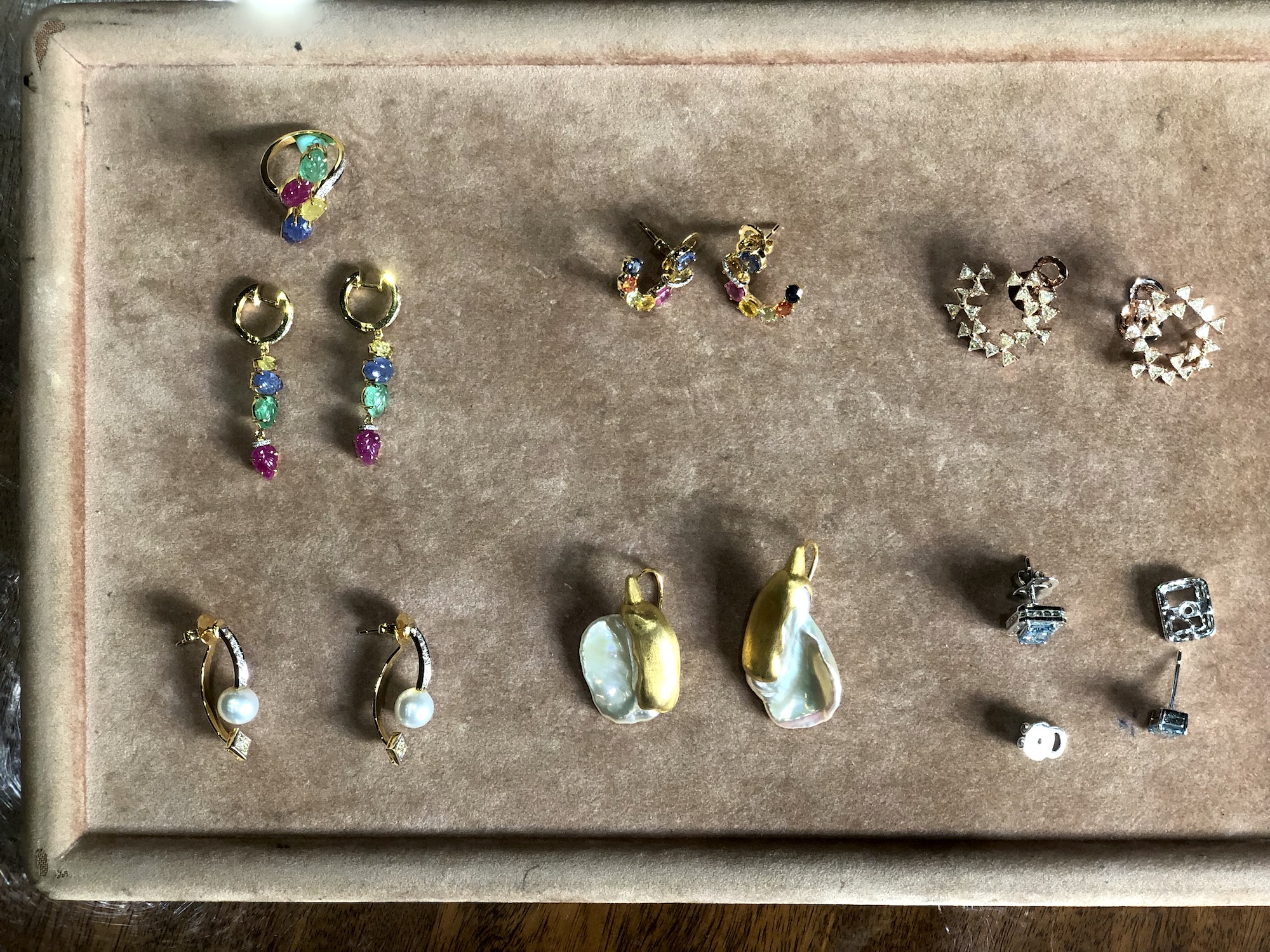
Jeweler Imelda Ramos-Rodriguez recalls an idyllic girlhood in Meycauayan, Bulacan akin to a Sanso Breton coast painting from the past century: Long walks by the fish pens facing Manila Bay’s northern coast, the waters checked by mangroves.
Returning home to the town proper, Ramos-Rodriguez would pass by residential streets with traditional capiz windows or then-contemporary art deco flourishes and hear the staccato of hammers, chisels, polishing buffs, and more.
In these breeze-swept streets, entire families, from dads and moms and aunts and uncles, to older siblings and cousins, worked on jewelry pieces, dividing the work amongst themselves in long, spacious, well-ventilated spaces – essentially the family living room for many.
It’s a memory the jeweler shares with fellow artisans from the city bordering Central Luzon and Metro Manila. Many jewelers working in Meycauayan actually come from nearby municipalities like Marilao, Sta. Maria, and Bocaue, which were historically part of Meycauayan’s territory.

Old Meycauayan has historically been a manufacturing center of the Philippines since the Spanish times, known for metallurgy, tannery, and yes, horology. During the 1896 Revolution, the city also produced arms for revolutionary forces.
Ramos-Rodriguez’s mother, Beatriz Floro-Ramos, was also a jeweler together with Imelda’s father, Ricardo Sr., a goldsmith. In 1971, Beatriz won a NACIDA award for a tektite piece which her small business created. The Ramos-Rodriguez family home still holds the telegram invite and program flow from the government body.
Old Meycauayan has historically been a manufacturing center of the Philippines since the Spanish times, known for metallurgy, tannery, and yes, horology. During the 1896 Revolution, the city also produced arms for revolutionary forces
Imelda herself was also recognized for a piece she crafted, a bamboo-shaped pendant hanging in a gold tubular necklace, emblematic of Meycauayan, which also represented the country in an international jewelry competition, chosen by the Philippine Government’s Center for International Trade Expositions and Missions.
Over the years, their jewelry quietly found its way into Manila’s old families—often marking life’s milestones in the form of gifts, heirlooms, and quiet symbols of love and legacy. Beatriz’s mother, Imelda’s grandmother, was also a jeweler.
Imelda and her siblings in the 1980s to early 2000s continued the family business, with Imelda first selling to female entrepreneurs and financial professionals in Makati and Quezon City as a side job before it became her full-time work.
A link in the chain
Today, Imelda’s daughter Patrizia is slowly easing in as a 4th generation Ramos-Rodriguez jeweler, having finished further studies abroad in gemology and jewelry design. I’ve worked with Patrizia before and we caught up via call, which eventually led me to take a bus up north to personally see the goings-on in one the Philippines’ oldest manufacturing hubs.

NoliSoli spoke to different artisans hailing from around Bulacan and even Pampanga’s border towns, now all based in Meycauayan. It takes various roles to complete a single piece of jewelry. Here, I witnessed a whole ecosystem of artisans, craftspeople, and tradespeople contributing both inherited knowledge and innovations, keeping Meycauayan’s jewelry traditions alive.
Looking at the bigger picture, new challenges beset the city long-hailed as the jewelry capital of the Philippines, but these very challenges can also, as the adage goes, reveal diamonds in the rough.
Need evolves into passion
Behind the jewelry world’s glitz and glam, there’s also a lot of grit. Amid precious materials like gold, sterling silver, diamonds, and colored stones, there are also noise and fumes that need constant soundproofing and ventilation. The big charm of Bulacan’s jewelry heritage thus lies in handcrafted techniques passed down and perfected across generations.
“I learned it from my parents, and their work served as a template for mine, I had no formal education, but a desire to learn,” Nilo*, a traditional platero or goldsmith shares in a mix of English and Filipino.
Nilo’s brother Federico* is also a goldsmith and they work side-by-side. The latter once worked in Mindanao and then abroad, before returning home to Bulacan as there’s “no place like home,” he shares in a mix of English and Filipino. Nilo was also detained in a West Asian country due to a technicality with his documents, but sees the experience as something enriching in the larger tapestry of his life.
Amid precious materials like gold, sterling silver, diamonds, and colored stones, there are also noise and fumes that need constant soundproofing and ventilation
Federico mentions two designs he’s proud of: challenging ringwork based on 20th-century classics and the links, no matter how small and intricate, in a chain necklace.
“Sa aking experience,” he continues, “kahit sabihin mong matagal ka nang platero, habang ikaw ay gumagawa, nag-aaral ka pa rin. Unlike sa gawang-makina na paulit-ulit lang, dito, mag-aaral ka pa rin,” expounding on how it’s a process of continuous education.
He takes pride in his work and the skills he’s honed for more than half his life but shares that he also returns to platero work because it’s the only trade he knows, that self-sustenance needs keep him at work despite being retirement age. His children already have work, yet none are interested in goldsmithing.

There are common designs that many can do like the traditional tambourine, which Bulacan is known for; Cabochons, where stones are set flat at the bottom but round and dynamic facing the viewer; Terno, where rings match an earring; and Huego, which is “kumpleto,” consisting of a set of rings, earrings, and bracelets.
Chito*, a mananara or stone-setter and etcher (and one-time tattoo artist) has after decades of practice come to learn that parts of jewelry work involve committed, hard skills while other parts involve a slower, more nuanced, more soul-involved approach.
Take for a example diamonds, which for him in a mix of English and Filipino “look nice, but which actually involves very simple stone setting,” in contrast to graba, which is an older form of jewelry etching practiced locally which Chito observes was common in decades past but is less and less practiced today.
“Mas matrabaho kase ang graba, hindi mo siya pwedeng piliting tapusin sa isang gawa. Magpapahinga ka rin dapat, kung pipiltin mo, pinapahirapan mo lang sarili mo,” he shares of the artistic process behind graba. He mentions that reliefs, especially those depicting faces are the most challenging – and fulfilling – graba forms that he’s continuously learning.
Bamboo roots
Rita*, who’s been a molder for most of her career in jewelry, explains that men traditionally worked as platero, due to the physical strength and labor-intensity required of the task. Women worked complementary roles as nag-iismiril or jewelry polishers, quality-controllers, and molders where the last role acts as the “archive” of finished pieces, where designs can be preserved for future use.
Surrounded by fellow women working the roles above, she shares how molding, quality-checking, and polishing are equally-important: They ensure continuity and consistency of design and also wearer comfort and piece longevity.
Amid the manual nature of jewelry-making, a lot of organizational skills are set and polished too, and Rita and her colleagues display this through a cataloguing system honed over decades to serve various clients
“Who tells the stories of those who wait while others work?” Rita muses in mix of English and Filipino as her colleagues a quality controller and polisher also chime in: “Mahalaga din ang gawa namin.”
Amid the manual nature of jewelry-making, a lot of organizational skills are set and polished too, and Rita and her colleagues display this through a cataloguing system honed over decades to serve various clients.
She also strongly believes that the jewelry made by her kababayan, in contrast to those made in the Middle East and Hong Kong, has a unique touch contributing to overall longevity. She adds that a lot of platero around the Philippines can trace the roots of their learning to Meycauayan’s heritage, “lilipat-bayan sila, pero bitbit pa rin nila ang tatak ng Bulacan.”
Her voice turns emotional as she says in a mix of English and Filipino, “I’m proud of Meycauayan’s jewelers. We’re not just representing [the province of] Bulacan, but the Philippines as well.”
In light of this, the Meycauayan Jewelry Industry Association for decades pushed for the establishment of the Meycauayan Jewelry Training Center trade school, which opened in November 1989 and continues to train aspiring artisans today from Bulacan and beyond.
Federico, the platero, believes that the younger generation needs new incentives to take up the reigns of their predecessors.
Over local palabok and dinuguan with puto, a shop owner tells me that other countries known for their jewelry industries have mostly automated the roles fulfilled by platero.
“There’s a shared emotional bond,” Imelda meanwhile shares, “you can’t part ways with someone you’ve built a bond with since your youth. And we work with precious stones, metals, and materials. Hardworking, trustworthy people in an industry like this are the true gems.”
As seen through the artisans above, a pride of place, a sense of heritage, and a reverence for history still remain among young and old alike in Meycauayan
And tying it all together in every workshop is the production manager, like Danny* who shares that his job involves mostly soft skills and emotional intelligence, helping smoothen the understanding and communication between jewelers, platero, stone setters, polishers, all as the whole floor collaborates to finish a single piece – among many lined up. Fatigue and conflict naturally arise, Danny muses, but these can also be the foundation upon which a team’s trust and cohesion is built over the years.
As seen through the artisans above, a pride of place, a sense of heritage, and a reverence for history still remain among young and old alike in Meycauayan. While the times seem to be changing, those who remain, remain as stalwarts.
Nilo, Federico, Chito, Rita, Danny, and the Floro-Ramos-Rodriguezes are all actually taking part in a heritage that’s uniquely Bulakenyo but also part of the larger story of human history. Ancient Egyptians were already studying the goldsmithing techniques of Egyptians more ancient than them and pre-colonial Filipino goldwork has been noted—and preserved—for their level of craftsmanship.
Meycauayan is named from a portmanteau of Tagalog words literally saying “there’s bamboo,” or “bamboo thrives.”
As the old parable says, bamboo’s strength and sturdiness lies in its pliability. Where trees with harder wood brave strong winds only to be toppled and uprooted, bamboo survives by bending where the wind blows, keeping its roots intact.
Perhaps there’s an apt metaphor here that may be applied to Meycauayan’s jewelry industry. But for now, there’s work to be done, and a horizon to walk towards. Like bamboo, the jewelers of Meycauayan bend, adjust, and quietly keep going—rooted, but never rigid.
*Names changed for privacy