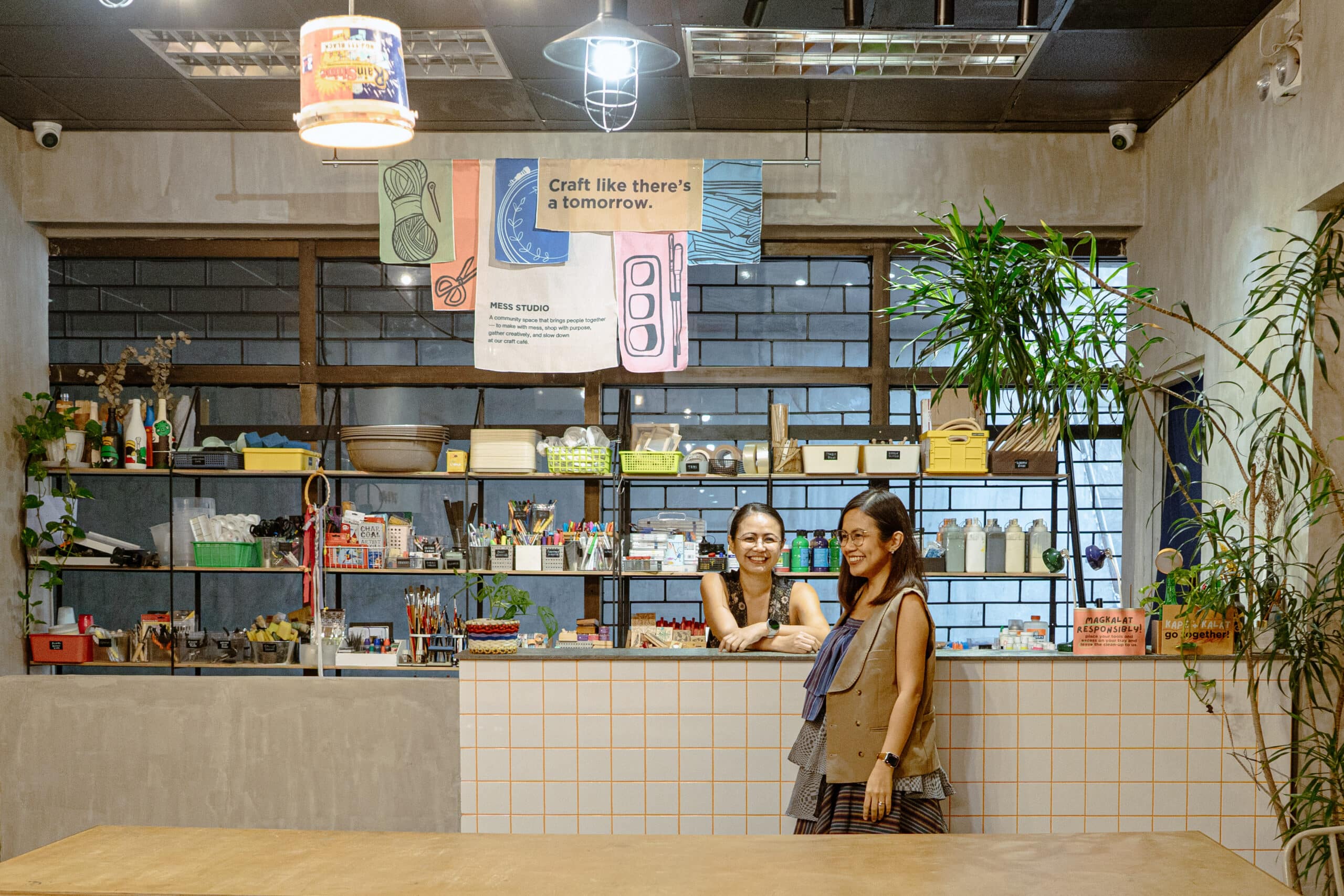
There’s something healing in being told that it’s okay to not get things right from the get-go. For a generation raised to be achievers, to be encouraged to embrace the mess and the imperfections is freeing. For the founders of Common Room, sisters Roma Agsunod and Maan Agsalud, it’s this spirit of playful creation that permeates every aspect of the brand. “DIY kami, a lot of the things we do, we just try it. You don’t really get good right off the bat talaga,” Agsalud says. “There are moments na ‘oh my gosh, ang galing ko pala.’ But most of the time, you really kinda suck at first. And I think a lot of people tend to shy away from trying because ayaw nila magkamali, or it feels like [they shouldn’t] do anything wrong. So hindi na lang sila magsisimula. Kami, hindi. Gawin mo lang siya! Wala namang masamang mangyayari if you try.”
Before Common Room, the sisters had already been running their own brand Pop Junk Love, starting with shirts with pins and brooches they DIY-ed from materials they had at home. It wasn’t even a passion for the arts that led them to start the business, but a need for extra financial support.

“When we were young, hindi talaga kami crafty people. But we were surrounded by it all the time,” Agsalud says. Their parents had been running an exporting business, so the sisters often found themselves surrounded by materials like paint and abaca. They also had a hand in packing orders. “We were exposed to it, but I can’t say we were really into crafting.”
“Actually nga, that exposure somehow made us not like crafting,” Agsunod adds. “Kasi it felt like we were being asked to work at a period where we were supposed to be playing. And then also, our parents didn’t want us to go into business.” So the sisters ventured into other pursuits—Agsunod in broadcast journalism and Agsalud in advertising—then after graduating, created Pop Junk Love as a side hustle. But with greater opportunities for their DIY craft brand, Agsunod felt it was a path with greater growth.
“I guess ’yong difference lang sa path namin ni Maan as small business owners is that when we were starting, it wasn’t passion. Parang marami kasing creatives and makers that we know now, all of their businesses are rooted in a passion. So ’yong samin, talagang it was a need, for us,” Agsunod says. In a sense, it was a passion and love developed over time. “It was definitely something that we loved doing and kept on doing kahit sobrang hirap.”
From spots in bazaars, Pop Junk Love eventually had its own mall kiosk. The sisters then saved enough to open a brick-and-mortar store, but thinking it was too big for just their brand, they shared the space with other makers and crafters. “Since we’ve been doing bazaars for almost a decade [then], we met a lot of makers and crafters who, like us, don’t have a permanent space to display their items. So that’s when we decided, why not share this space with other makers?” Agsunod says.
The 33 makers in their first Katipunan store all decided on the name “Common Room.” Ten years later, Common Room now has five branches and over 300 makers on its roster.

Bless this mess
While writing this story, I came across a TEDx talk by writer and creative coach Amie McNee. “‘Creativity is the missing pillar of self-development,’” she reads from a poster. “We are a culture that is obsessed with optimization and productivity… We’re looking at meditation practices, sleep practices, exercise practices, how we can optimize and be the best version of ourselves. [But] no one’s talking about creativity. No one’s talking about making stuff. It is the missing pillar of self-development.”
It made me think of Common Room’s biggest and most experimental iteration, located at The Atrium of Makati, where in their Mess Studio, they openly encourage everyone to simply create.
“When you see them shop here, nakikita mo na na-appreciate nila ’yong trabaho ng mga makers, and also a lot of them feel empowered, na ‘maybe I can do that also,’” Agsalud says. “Ang gandang ecosystem niya, na they are inspired by other people’s work. And siguro we always wanted to have that space that we can hold both of those types of communities together.”
At the Mess Studio, anyone can come in to try their hand at various crafts, all making use of scraps and donated “trash” to be upcycled into creative projects. This is another goal Common Room hopes to help address. In a corner of the store, a banner proudly states: “Crafted, not wasted: 1,149 kg trash saved from the landfill.” The numbers keep on growing.


But more than anything, what the Mess Studio also aims to encourage is to get more people to simply create. “You really learn through the doing eh,” Agsalud says. The sisters are a testament to this, as the past 18 years of Pop Junk Love and the last decade of Common Room have shown. “Through the doing, even if you’re overthinking, as long as you are doing something, you are learning along the way. I think hindi mo siya talaga malalaman unless you try it out. That’s why we have a lot of making events.”
“And I think medyo liberating din ’yong idea na magkakamali ka. Kaya siya ‘Mess Studio.’ When people have craft parties here and they say, ‘oh, sorry makalat!’—Okay lang magkalat!” Agsalud adds. “It’s liberating in a sense na you don’t have to limit yourself to doing one thing or something right the first time. It opens you up to just being playful, being experimental.”

Creativity in every facet of life
Working with more than 300 makers and creatives and running Common Room for 10 years now, Agsunod and Agsalud’s ideas on creativity have evolved.
“For me, creativity is not just the creativity in making. [It’s also] in your system, in your processes. It’s not just releasing your products,” Agsunod says. “So from that angle, it becomes like creativity as a problem-solving challenge. How can we create a better system? Create a better user flow? When you look at creativity that way, then there will always be a next step.”
Agsalud echoes this, adding that an element of play is what makes problem-solving creative. Problems and decisions in day-to-day life can involve the playfulness of creativity, even tasks that seem as mundane as choosing how to go to work, or making your meals, or even just picking out clothes, she says.
Being surrounded by so many makers and ideas, it makes you wonder how they sustain the creative energy. “Sometimes there is a creative rut because creatives try to doomscroll and look for inspiration elsewhere, and then find out that [someone else has done their idea.] It’s very external. So for me, I always go back to what do I want to do? What haven’t I done? Then I’ll do it. Regardless of [if they’ve done it.] Kasi if I do it, I’d probably do it differently,” Agsunod says.
“For me, the mantra is, ‘What do I still want to see?’ And I do that.”