A question that lingers when facing the new Helm menu is whether you value the reputation that precedes it or the new expectation placed upon it. Do you come in thinking about the past performance or do you step into its potential free from preconceived notions?
Either way, it’s a tough position to be in if you’re Josh Boutwood, chef of the first and so far only Philippine restaurant to hold two Michelin stars. Given the level of challenge only he understands right now, it’s clear that Boutwood returns with the mindset as if it’s just another day at the office.
READ: Female friendship serves empowerment and fantastic Filipino food

Simply dubbed Single Ingredient, Boutwood’s nine-course experience is shaped around one product that lets guests appreciate unfiltered expressions of tuna, pumpkin, lobster, bread, cod, lamb, lychee, wagyu, and chocolate.
“It’s really an ode to the ingredients I enjoy working with and eating,” he says about the decision-making process. “But they are positioned in a way that creates a kind of undulation of profiles of flavors… It’s not a singular line of progression; it’s a journey that goes up and down in certain places.”
“It’s really an ode to the ingredients I enjoy working with and eating,” he says about the decision-making process. “But they are positioned in a way that creates a kind of undulation of profiles of flavors”
This kind of judgment shows Boutwood as someone secure enough in himself that his tasting menus can encompass any shape, form, redesign, alteration, Harry Potter universe, or monochromatic staging on a plate. Close to two decades in the industry gives you credibility, after all.
However, Single Ingredient is also a reminder that a tasting menu is not a monolith; that while classic structures of progression and flow of flavors exist, there is no one way to create a tasting menu and there is no one way to be Josh Boutwood.

Like when he continues to bravely slap a cinematic bread course of sourdough and brioche with an elegant spread of Italian olive oil, cubed caramelized butter, herbed pork fat, and caviar butter in the middle of the meal (one he probably pioneered). Or when he changed the lobster and lamb courses last minute.
“I really cleared some space in my mind [to the point] where I’m able to look at things differently,” Josh Boutwood explains of his method
“I really cleared some space in my mind [to the point] where I’m able to look at things differently,” Boutwood explains of his method. “Like, oh, you know what? We can actually change this and do it a little better. If we layer it like this, we’re able to do it like that, and the flavor impact is going to be different.”
Shooting for Michelin stars

But the question any editor, journalist, or those of us who write about food, or any creator or consumer really, need to start asking is whether we are putting the weight of expectations ourselves on Boutwood, who, on the night of our visit, seems to float around the space like his usual relaxed self. The weight of expectations on whether the new menu lives up to its two Michelin stars will never not be present but it is a sentiment that perhaps we need to address within ourselves first.
READ: Spanish chef Luis Martinez and his new point of view
The real story here is more about Boutwood living up to his own expectations, and the reality is that he simply finds “a lot of satisfaction out of simplicity”—both in his food and in his ways of seeing things
The real story here is more about Boutwood living up to his own expectations, and the reality is that he simply finds “a lot of satisfaction out of simplicity”—both in his food and in his ways of seeing things. That whatever comes out of this new release, it doesn’t change the fact that this is still the next step in his and Helm’s journey. “And I’m enjoying this one a lot. This is a fun menu to do,” he shares.
Menu engineering around a single ingredient

In archetypal Boutwood, the results speak for themselves. As you make your way through the snacks of lightly smoked trout, lobster buchi topped with lime kosho, and wagyu tartare brightened by shiso leaf, you find yourself imagining the Boutwood mood board and reimagining the codes that contextualize the ingredients.
Here, he takes you on a journey from ocean to soil, reminding us that storytelling is a key ingredient in a great menu. The strongest moments come right at the beginning when Boutwood rolls right into his opening salvo of tuna, pumpkin, and lobster.
The strongest moments come right at the beginning when Boutwood rolls right into his opening salvo of tuna, pumpkin, and lobster
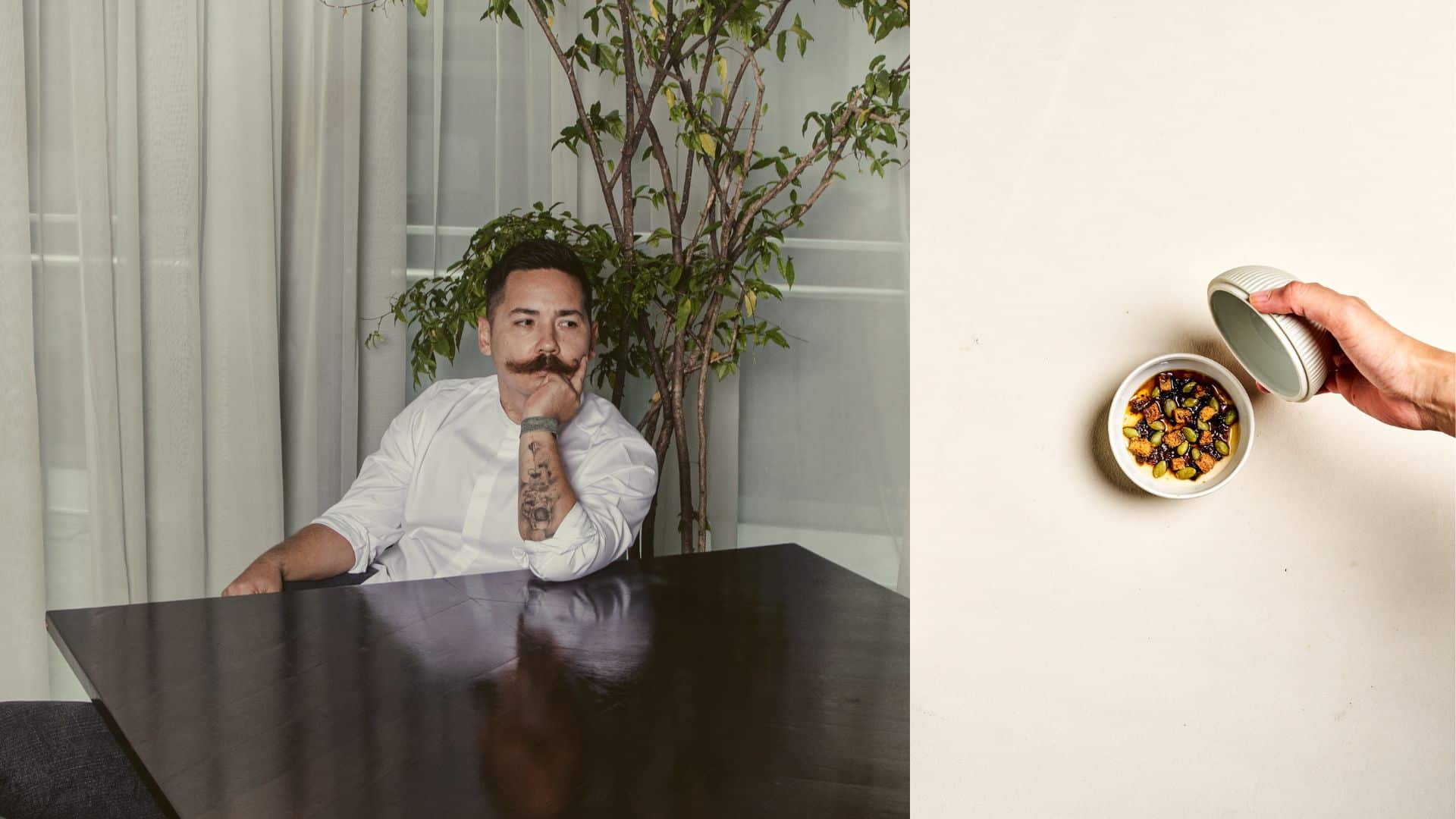
A little stack of a tuna opener built on fatty otoro and lean akami is buttery and creamy, thanks to a mix of miso emulsion, tuna roe foam, and a crisp wafer with tomato powder dusting. His next course is practically pumpkin on steroids, utilizing the nutty fruit in all possible idiosyncratic iterations—from pumpkin custard, diced pumpkin, and pumpkin skin XO to roasted pumpkin seeds, pumpkin lacto-ferment, and pumpkin foam—to get that snappy crunch and toasty crackle with each bite.
The succeeding lobster course is more assertive than anything he has previously produced. Boutwood turns the precise science of poaching the crustacean at 59.5 degrees, the ideal temperature to cook lobster tail and yield a succulent bite, into fine art. It is potent on its own, but paired with a sauce of fish bone broth, shrimp oil, and a crustacean sabayon, and garnished with pickled Granny Smith apples and onions, it enters a transformative realm.

Boutwood’s aforementioned bread spread hogs the spotlight next. “Bread is one of those things that is so ancient yet so humbly simple, and what better way to draw focus into something as ancient as that than to create a whole course around it?”
His approach with cod, delicately steamed and flourished with white cauliflower puree and confit bacalao, is created with distinct details you have to pick through. There are pickled ribbons of kohlrabi (a root crop in the family of cabbage but resembles a turnip) for acidity and a tapioca cracker for texture.
“Bread is one of those things that is so ancient yet so humbly simple, and what better way to draw focus into something as ancient as that than to create a whole course around it?”
READ: F&B briefs: Long Bar takeover, Undō by Mōdan pop-up, and A Mano’s new pizza chef
By the menu’s second half, you encounter a minor speed bump in the lamb course—though it could partly be down to personal preference. The roasted lamb tenderloin and, to an extent, the mole-drizzled lamb terrine are more robust and gamey than usual (perhaps sourced from Australia or New Zealand); that said, Boutwood goes out on a lamb (yes, pun intended) with components, like a watercress sauce and onion purée, that reinforce his theory of “comfort zones.”

“I establish a common ingredient that is known to go well with lamb and expand on that up until I reach a point where I am out of my element,” he wrote in his F&B Report column in 2015.
After a refreshing lychee sorbet break, the next main of roasted A5 wagyu striploin from Miyagi, Japan remedies the little lamb letdown. Here, he glazes the silky wagyu with aged miso for a powerful savory-sweet umami effect but scales it even more with an earthy sunchoke purèe cooked in wagyu fat and a woozy sauce made from beef bones and bone marrow.
As one of the most decorated chefs in the country, he navigates his newfound Michelin fame with candor, and it shows in his latest work that feels constantly in motion and aware of the zeitgeist
Finally, dessert leverages the Boutwood catalog with his signature Chocolate, chocolate, chocolate course, concocting a classic craveable dessert that balances sweet notes (burnt white chocolate), crunch (chocolate crumbs), and dimension (chocolate foam under a veil of white chocolate). Even the final petit four of canelé, brown sugar sablé cookie, and dark chocolate fudge and sapin-sapin, all enjoyed with single-origin coffee from Guatemala, scale the peaks of his consistency.
The boss has other ideas

As one of the most decorated chefs in the country, he navigates his newfound Michelin fame with candor, and it shows in his latest work that feels constantly in motion and aware of the zeitgeist. An observation though: This time, the non-meat courses, particularly the opening trio of tuna, pumpkin, and lobster, or even the cod (though Boutwood personally is always at his best with fish), greatly outweigh the meaty impact of the lamb and the wagyu, unusual for a chef whose pork chops and dry-aged ribeyes regularly receive rave reviews.

However, the overall picture is that there is plenty to admire and appreciate about Helm’s new menu. What’s noticeable is that while it doesn’t seem he takes any gigantic steps forward, Boutwood commits to his vision, refusing to half-ass anything, which in itself is already a quantum leap in today’s fickle foodservice landscape.

And yes, it is a solid menu, but Boutwood’s blithe carefree spirit is profoundly palpable, too, which is the primary driving force here. That in “simplifying” his approach in an otherwise complex situation he finds himself in, with two stars on the line, Boutwood decides not to get swallowed up in the potential circus of it all.
If that isn’t a boss move from Boutwood, I don’t know what is.