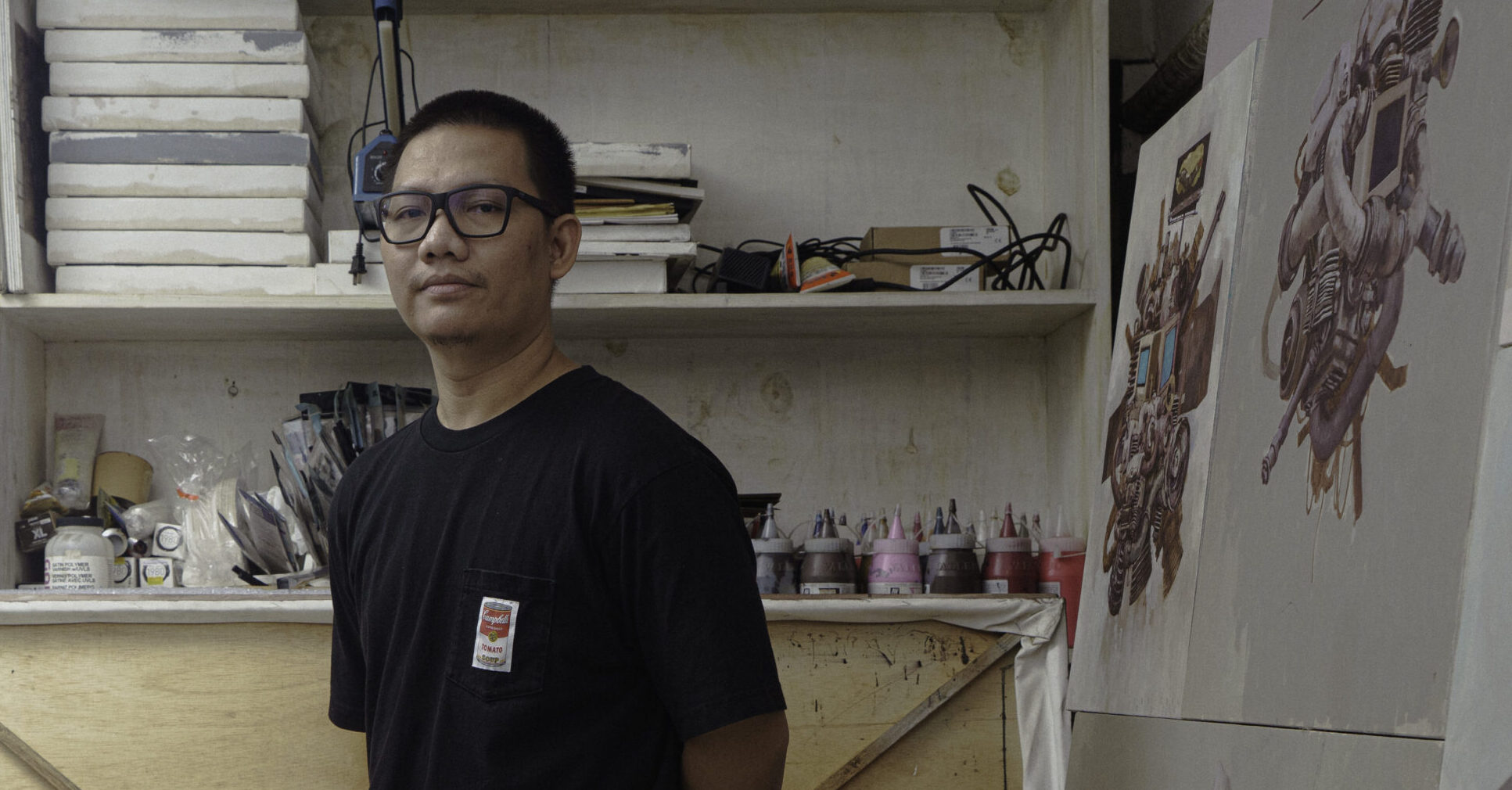
Artist Keb Cerda scuttles around his midcentury house and studio in the south. “The Big Bang Theory” sci-fi spin-off “Stuart Fails to Save the Universe” hums in the background, as the scent of cookies baked by his wife Lori wafts in. While their son is at school, a range of Lego toys (many Star Wars-themed) are scattered throughout the room.
Cozy, a little nerdy, and undeniably warm, the living space seems to set the foundation for the caring premise his artwork sets.
In the neighboring room, however, Cerda’s studio is a different world. His stacked artwork fills the space, and next to them, rows of computer screens—hinting at how in his process, the technology and the canvases go hand-in-hand.
“I’m an artist and aspiring, or frustrated, video game developer,” Cerda laughs. “And a world builder.”

“I’m an artist and aspiring, or frustrated, video game developer… And a world builder”
Creating paintings that are playable and interactive, Cerda projects augmented reality through his work. Using motion sensors and complex programming, he paints in a niche that hasn’t really been tapped before, especially in the Philippines, with works that are playful, a little nostalgic, and always participatory.
Paintings into portals
As Cerda explains his fascination with games, it’s clear that he’s one of those people who never stopped playing—be it video games, board games, or RPGs. And when it comes to painting, a painting that ends at the canvas seems almost incomplete. “I always want to invite viewers to interact with ’yong artwork mismo,” he says. “Pumasok sila doon sa world na ginagawa ko.”
This is visible through his earlier works such as “Super Nardo,” a Super Mario-like game where the character collects coins through three hand-painted levels. Then there’s the blue-and-purple-tinted twilight of “Dahlia,” placing viewers inside a dystopian city dominated by surveillance and technology. Meanwhile, “Atomic Blob” turns war scenes into a two-player game that comments on violence and aggression.
More recently, in Cerda’s “Dopamine Dash,” players need to grab as many positive reactions (like love and laugh emojis), which explores our endless pursuit of social media stimulation.
And through the brilliance of it all, Cerda uses this language of games through sophisticated technology, questioning the systems and culture around us.
What started with a four-year-old
Now, with his newest series of work, “Probably a Robot,” the world he is building is much more personal.
The creatures in “Probably a Robot” began with Cerda’s young son, who had a habit of taping random things onto his toys and calling them “upgrades.” “Naubos ’yong masking tape ko,” Cerda recalls with a laugh. “One time, na-curious na talaga ako, ano ba ’yong ginagawa mo? Sabi niya, parang creatures daw.”

It turned out the creatures were invisible. Cerda’s son pointed toward an empty space and explained he was making creatures he could see. Cerda initially wondered if there might be a rat hiding somewhere, but realized his son was imagining an entire population of beings.
From there, father and son started documenting, almost like two scientists studying a newly discovered species. “Doon nag-start ’yon. Dine-drawing na namin sila. Ino-observe namin sila. Para kaming Nat Geo. Kuno doon nag-drawing kami ng kung ano-ano, kunwari nakikita namin. Sinakyan ko na lang.”

The drawings became a kind of bestiary, as Cerda would sketch alongside his son. “Sometimes ko-correct niya ’yong ibang parts, ‘mali ’yan, ganito dapat.’” Eventually, Cerda turned those creatures into paintings, but even then, he felt something was missing.
“Na-realize ko parang bitin pa rin. Bitin pa rin ’yong imagery. What if gumawa ako ng way para ma-interact namin sila, ’yong creatures na ’to na hindi namin nakikita.”
READ: Where the window is a cage: Pope Bacay’s ‘What We Hold Sacred’
Like a Tamagotchi
“Probably a Robot” is Cerda’s latest series of oil paintings accompanied by an augmented reality experience. Some of these paintings were recently exhibited in group exhibitions like at León Gallery International’s “Fervid” as well as at 603 Arts Foundation’s inaugural exhibition, “The cataclysm of binary star systems” at Nunu Fine Art in New York.
There, Cerda debuted his work “Unknown Mechanism Yet,” and also joined artist María-Elena Pombo and New Museum curator Dr. Vivian Crocket for a conversation on culture and technology.
If you point a smartphone at one of the “Probably a Robot” paintings, the creatures come alive, allowing viewers to feed, clean, pet, and care for them, while their condition changes depending on how they are treated. Cerda calls it a Tamagotchi-like experience, but there’s a caveat: There are no obvious instructions telling you what to do.
“Sa game wala siyang meters. Kunwari sa Sims may hunger meter, so alam mo kung kailan sila magugutom, ’di ba? Pero dito I eliminated ’yong ganoong UI.”
Instead, you have to figure it out yourself. “Kasi ganoon naman talaga sa care, ’di ba? Sa anak, sa pets, sa anong kine-care nating bagay, kung anong priorities natin.”
“Kasi ganoon naman talaga sa care, ’di ba? Sa anak, sa pets, sa anong kine-care nating bagay, kung anong priorities natin”
The Tamagotchi-like playfulness gives way to a much more tender idea, as Cerda is interested in what happens when we are asked to care for something without being given a clear set of instructions. “We learn from trial and error,” he states. “We take care of systems na we don’t fully understand.”
READ: 9 artists trace the wild paths of growth in ‘Where Vines Grow Wild’
Building a world out of care
There is also an even more personal story underneath the robots. During the making of the work, Cerda and his family lost their pet, a German Shepard dog Ada. “Para siguro ma-fill up ’yong void ng loss.”
So while the paintings may look like machines, pipes, screens, propellers, strange mechanical limbs, and all, they are ultimately asking a very human question: What does it mean to take care of something?

For an artist who describes himself as a frustrated video game developer, the self-taught systems maker may not have ended up making video games in the conventional sense. But he has found another way to build a world and invite people inside.
And it’s in these worlds, like all worlds, that only continue to exist because someone chooses to care for it.