The creatives behind the Ilocano boys’ love (BL) series “All the Things I Leave You (Patawid)” don’t necessarily see the project as something that will push the genre’s evolution in the Philippines. But if there’s anything it hopes to achieve, it’s to remind us that BL stories are human stories. They can be told in different languages or happen in different places, but in the end come down to a shared experience.
“These stories exist in the regions, but we don’t always see them. And while there’s universality in our experiences, there’s also uniqueness—and that’s always worth seeing,” director Jade Castro says. “I think ‘yon ang ambag namin—whether it ends up just that or a step toward evolution.”
“These stories exist in the regions, but we don’t always see them. And while there’s universality in our experiences, there’s also uniqueness”
‘Love is love’
“Patawid,” which means pamana in Tagalog, is a six-episode mini-series shot in Laoag and San Nicolas in Ilocos Norte. It follows Jorge, a privileged but aimless young man, and Kiko, a street-smart motorcycle rider, played by Benedix Ramos and Justin Paul Basobas—Ilocano-speaking actors from Pangasinan.
The two are forced to work together at a family-run restaurant owned by Jorge’s grandfather Tino, a retired migrant farm worker, or sakada, in Hawaii. When Tino dies, Jorge and Kiko discover a box of unsent letters and photographs that reveal a decades-old love story between Tino and his best friend, whose lives were defined by migration and sacrifice.
As they discover this secret past—depicted through memories from the 1940s—Jorge and Kiko’s own relationship begins to grow, leading them to questions about love and legacies. It also explores how class informs intimacy and desire.
“Makikita dito kung paano magmahal noon at kung paano magmahal at tumanggap sa present times. But at the end of the day, wala naman talagang pinagkaiba—it’s love,” Ramos says. “Mas may restrictions noon, pero ngayon, more than ever, love is love. We can allow ourselves to love and be loved.”
READ: Unleashing the Brown Madonna
“It’s about what the older generation leaves behind and what we leave each other—even in love. It can take many forms,” Castro adds.
The voice of the community
As a Caviteño, Castro had initial misgivings about taking on the project; he believed there were Ilocano directors out there who could tell the story more faithfully. But based on the style and tone of Castro’s past BL work, like “Boys’ Lockdown,” producer Alemberg Ang and creator Lance Collins felt he was the right person to take the helm.
Castro eventually accepted the offer—provided that he would work closely with Ilocano creatives to guide him through the process.

While people often think of the director as the voice of a project, it’s a notion that Castro has always rejected. He believes he’s just a tool in the larger scheme of things. And he has never felt that more strongly than while directing “Patawid.”
“Our writers and interns were Ilocano. Ang daming members of the LGBTQIA+ community na tumulong sa ‘min while we were shooting in Ilocos,” Castro says. “It really felt like the voice of the local community speaking.”
“Our writers and interns were Ilocano. Ang daming members of the LGBTQIA+ community na tumulong… It really felt like the voice of the local community”
The result is a tender love story that depicts the acceptance of queer love while highlighting the richness of Ilocano culture—from its language and food to its landscapes, family values, and local rituals. Throughout the series, Jorge and Kiko show the ways “ay-ayaten ka” or “mahal kita” can be expressed without words—through panagpakan or perhaps through simple long drives on open roads.
“The series is sprinkled with details and nuances that you will only catch if you’re Ilocano,” Castro says.
Life is worth celebrating, too
The series has already made the rounds of various international festivals, including festivals in the United States, China, India, and Argentina. Now, in hopes of reaching audiences across the country—especially in Ilocano-speaking regions—“Patawid” screens all six episodes back-to-back exclusively at SM Cinemas.
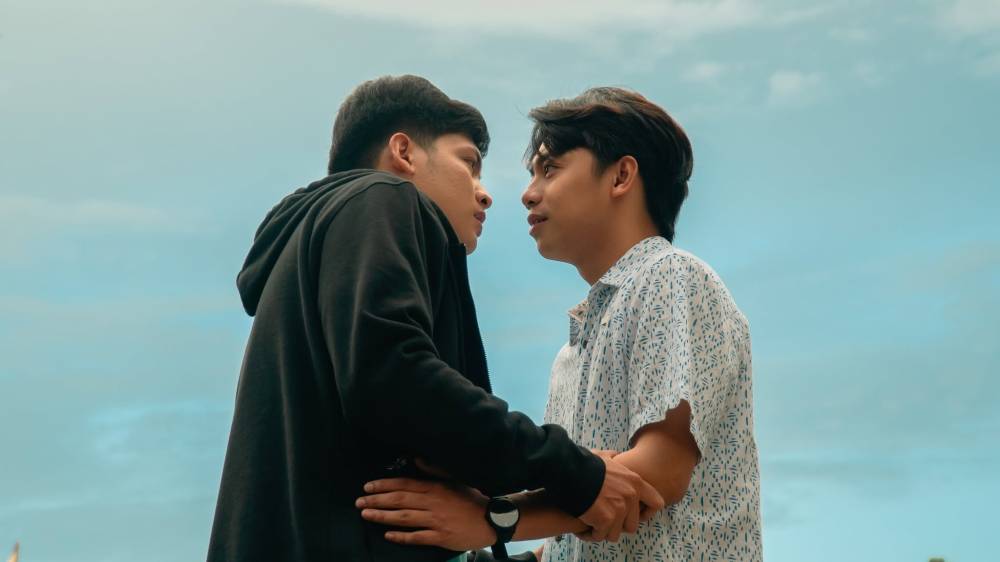
“Nakakatuwa na finally, we have this kind of regional representation—and in a BL series at that,” Ramos says, noting that some foreign viewers even mistook “Patawid” for a Thai or Indonesian production, which, he adds, opens up an opportunity to further highlight Filipino languages.
READ: ‘Macho Dancer,’ Vice Ganda lead FDCP’s Pelikulaya 2026
“Maybe part of the evolution of BL is us owning our own languages. And I hope we see more series or films that use our native languages—Kapampangan, Bisaya, and more,” Ramos says. “Sa atin ang mga language na ‘yan, and they’re part of our Filipino identity.”
But more than representation, “Patawid” also tries to show that queer stories don’t always have to be defined solely by struggle. And while such narratives will always be important, the series also serves as a reminder that life, too, is worth celebrating.
“The struggle is still there, but there’s also positivity,” Castro says. “I want to tell everyone that we can fight the fight, but also allow ourselves to have fun and be happy.”