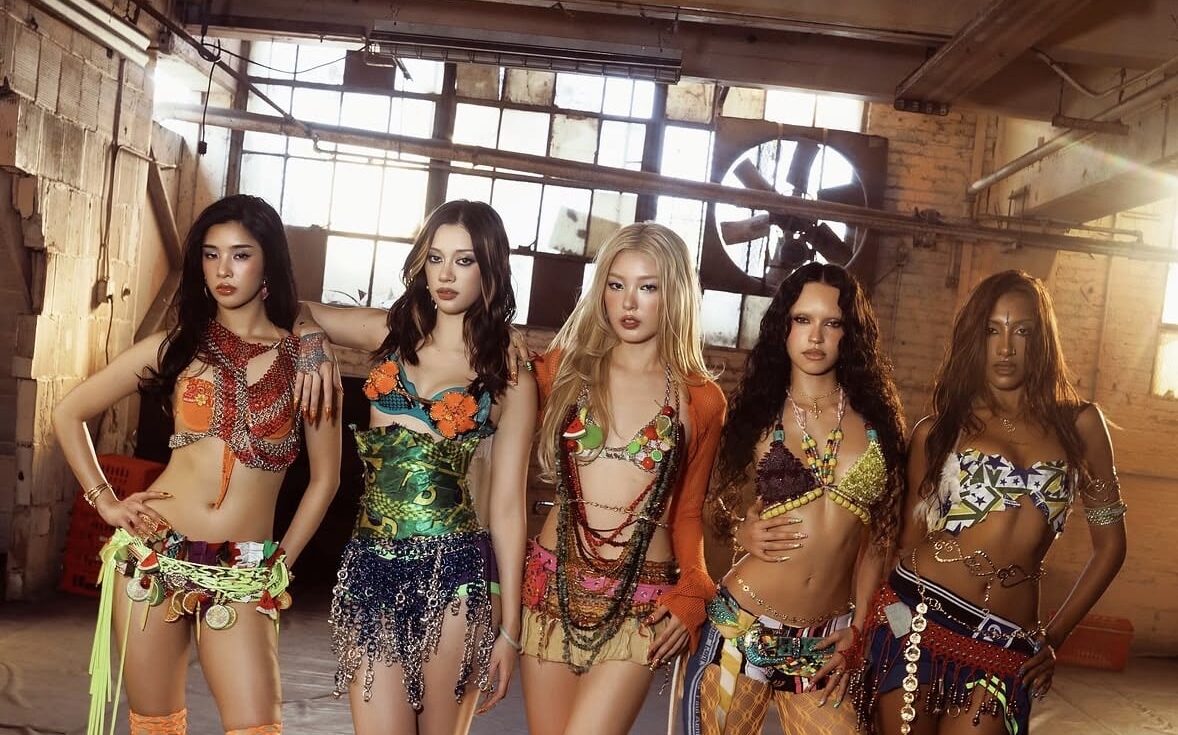
Many young girls grow up fearing their own appetites. They’re taught to clip their legs, slow their ingestion, and center their attention on the prime job of being a woman—industriously studying their role within a strict binary and adopting it seamlessly throughout their existence. Any form of consumption, from space, to food, to literature is implicitly or explicitly discouraged.
So when pop music enters their lives, spearheaded by the likes of Madonna, Britney Spears, and now Sabrina Carpenter and Tate McRae, it’s inherently subversive.
READ: The parasocial nature of hatred
For the impressionable young girl, any woman demonstrating a kind of prowess, all the more if it’s sexual, introduces her to her potential to break the mold, to reject modesty as the highest of virtues, and exercise her autonomy.
But in a society where autonomy is not just controlled by means of gender, but also capital, empowerment can quickly veer into exploitation. When the image of Spears in a bra and booty shorts singing “Slave 4 U” with an anaconda draped across her neck starts to sell, the questions begin to form: What is actually happening in this transaction? Is it the idea of female sexual agency that is being sold to us, or merely the idea that one can pay a woman to wear less and less clothes on stage?
Are our pop icons conceiving their own fantasies, or are they simply cosplaying in the twisted realm of a man’s commercial imagination?
The evolution of girl groups
Long before Katseye made it big, The Spice Girls led the girl group craze in the ‘90s with hit songs like “Wanna Be” and “Spice Up Your Life.” But they explored a different dynamic than what we are used to seeing in girl groups today.
Each member of the group—Mel B, Melanie C, Emma Bunton, Geri Halliwell, and Victoria Beckham—had their own distinct persona. Though possibly simplistic by today’s standards, they each represented a variation of feminine expression.
In contemporary girl group culture, this variety is glaringly absent. The members of the girl groups of the 2010s, like Fifth Harmony for example, each express femininity the exact same way. A new monolithic model of girl groups took over.
And while The Spice Girls themselves held about 80 percent of the writing credits in their catalog, the members of Fifth Harmony did not write most of their early music. The most visually and lyrically explicit of their singles “Work From Home” and “Worth It” were composed by external songwriters and producers.
Following Fifth Harmony, Western girl groups started to dwindle down as both artists and audiences favored soloists. It was then that Kpop girl groups began to generate mass global appeal.
Enter Katseye.

The forming of Katseye
Many of us sat back and watched how this global girl group was formed through the highly produced Netflix reality show, “The Debut: Dream Academy.” We witnessed the shock on the girls’ faces as they were revealed to be contestants on a competition show—the particular conditions of their participation previously undisclosed to them.
Amid the chaos of this revelation, many of them expressed discomfort with having been pit against one another in that setting, especially as fans became increasingly involved in ranking and eliminating friends-turned-competitors. Lexie Levin, a former member of the succeeding Hybe x Geffen girl group innovation Saint Satine, even withdrew from the competition upon discovering the manipulative tactics of the show’s producers.
At this point in history, we are enjoying the fourth and fifth generation of K-pop girl groups with groups like Aespa, NewJeans, Le Sserafim, and Illit. But there’s something peculiar about Katseye. It doesn’t only stand out because it is a joint venture between a Korean label and an American one, but because their market appeal has taken an odd, yet unsurprising turn.
Le Sserafim, who is also under Hybe, doesn’t seem to be producing music or visuals that are even close to the sexually explicit nature of Katseye’s brand identity. Even songs like “Hot” and “Spaghetti” register as more edgy than aroused. Whereas Katseye, in its attempt to be everything at once, surfaces as nothing at all.

Instead of grounding their marketability in cultural nuance and diversity, they lazily opt for something more universal: sex appeal.
Girl groups of today no longer represent themselves as artists, but as cogs in a larger machine. And perhaps no other collective appeared as well-oiled as Katseye, that is, until the hiatus of both Manon—the sole Black woman in the group—and Sophia, one of two members who did not grow up in the United States.
READ: Forever chalant, Janine Berdin
So where does Katseye’s controversy lie?
This all points to how little control the individual members have on their creative direction and public personas. Since their debut, they have released three EPs and zero full-length studio albums. They also have yet to establish their musical identity—frequently jumping from various genres and styles at a rapid pace.
Perhaps this inconsistency can be attributed to the different strengths of its members, with Daniela contributing to the Latin-infused pop in “Gabriela” and Yoonchae contributing to the more K-pop characteristics in “Touch.” But for the most part, Katseye has been releasing techno-pop reminiscent of AI slop, with lyrics so incoherent they go viral on the nonsense alone.
“Gnarly,” “Pinky Up,” and “Hootie Frutti,” are among their latest lyrical unintelligibilities. The absence of full-length albums and lucid lyrics directs us to its target audience: the growing generation of consumers who are most accustomed to consuming brainrot—Gen Alpha.
When the music video for “Hootie Frutti” was released, many viewers deemed it terribly inappropriate for young audiences. In the video, the girls are once again in skimpy outfits, grinding on motorcycles and air-humping in almost every shot, as sweaty and as horny as visibly perceptible through a screen.

That said, the issue to me is less the matter of the active sexuality portrayed than the fact that Katseye themselves seem to have little agency in the matter. They don’t write any of their own songs (except for a track Lara wrote for the latest EP that isn’t even available on streaming platforms). And they certainly don’t control their music roll-out.
While many have defended Katseye’s management by reminding audiences that the members are adults, their being of age does not automatically guarantee their ability to advocate for themselves.
And ultimately, the issue isn’t even about Katseye or whether its individual members are comfortable dancing and dressing the way they do. Individual actors can and often have endorsed their own oppression.
The issue surrounding Katseye is about continuing to question the mainstream, and whether it resists or reinforces the systems that subjugate women.