Street art is one of the most visceral and accessible modes of creative visual communication. By converting public walls into expansive pictorial worlds or infiltrating inconspicuous corners with stickers, street artists drag viewers straight out of the mundane.
READ: For Keb Cerda, paintings are worlds waiting to be played
Its public nature gives it a unique cultural gravity—each piece inextricably tied to its site-specific context. Whether rendered as larger-than-life murals, wheat-paste interventions, or painted cling wrap stretched across urban spaces to make strange two-dimensional figures appear suspended in mid-air, street art reclaims the city as a canvas.
Much of street art’s resonance stems directly from this radical democratization of access. Materially and contextually, it liberates the aesthetic experience from institutions often perceived as hierarchical or exclusionary. Where traditional venues enforce barriers—from admission fees to geographic isolation within affluent commercial districts—street art takes root directly in the most public of spaces.

Artists like Banksy have pushed this ethos to its extreme, bringing art far beyond the gallery network and into communities stripped of access entirely. By painting on bombed-out buildings in war-torn regions like the Gaza Strip in 2015, his work does more than conjure an imagined world amid ruins—it restores moments of human dignity to the most marginalized, proving that visual art can exist as a vital, ungatekept right for everyone.
From eskinita to Bangkok’s streets
Enter Blic, a Filipino visual artist whose work has invaded both the eskinita and gallery walls locally and internationally. His moniker—a truncation of the word public—is a direct nod to the core of his practice as a Cavite-based street artist who draws from urban grit as a limitless source of visual and narrative inspiration.
Over time, Blic has built an expansive body of work—distinguished by an unmistakable iconography, ambitious scale, diverse modes of production, and an instinct for unexpected urban locations.
His current solo exhibition at Bangkok’s Joyman Gallery, “Hard Shifts,” brings the immediacy of the street directly into the white cube. Paradoxically, Blic veers away from street art’s typical reliance on site-specificity. Rather than leaning on familiar Bangkok landmarks or Thai cultural motifs, he relies on his signature Taong Kamay iconography to explore universal human experiences.
In doing so, he remains true to his established visual idiom while subverting the expectation that street art must always mirror its immediate locale.
READ: ‘Girl with a Pearl Earring’ in Japan, perhaps for the last time
That universality sits at the heart of the show. “In one of my works,” Blic shares, “there is a figure walking into the darkness, and along the path he has traversed, flowers are blossoming. It is my way of saying that if we can find the courage to push through the unknown, hope will mark our way.”
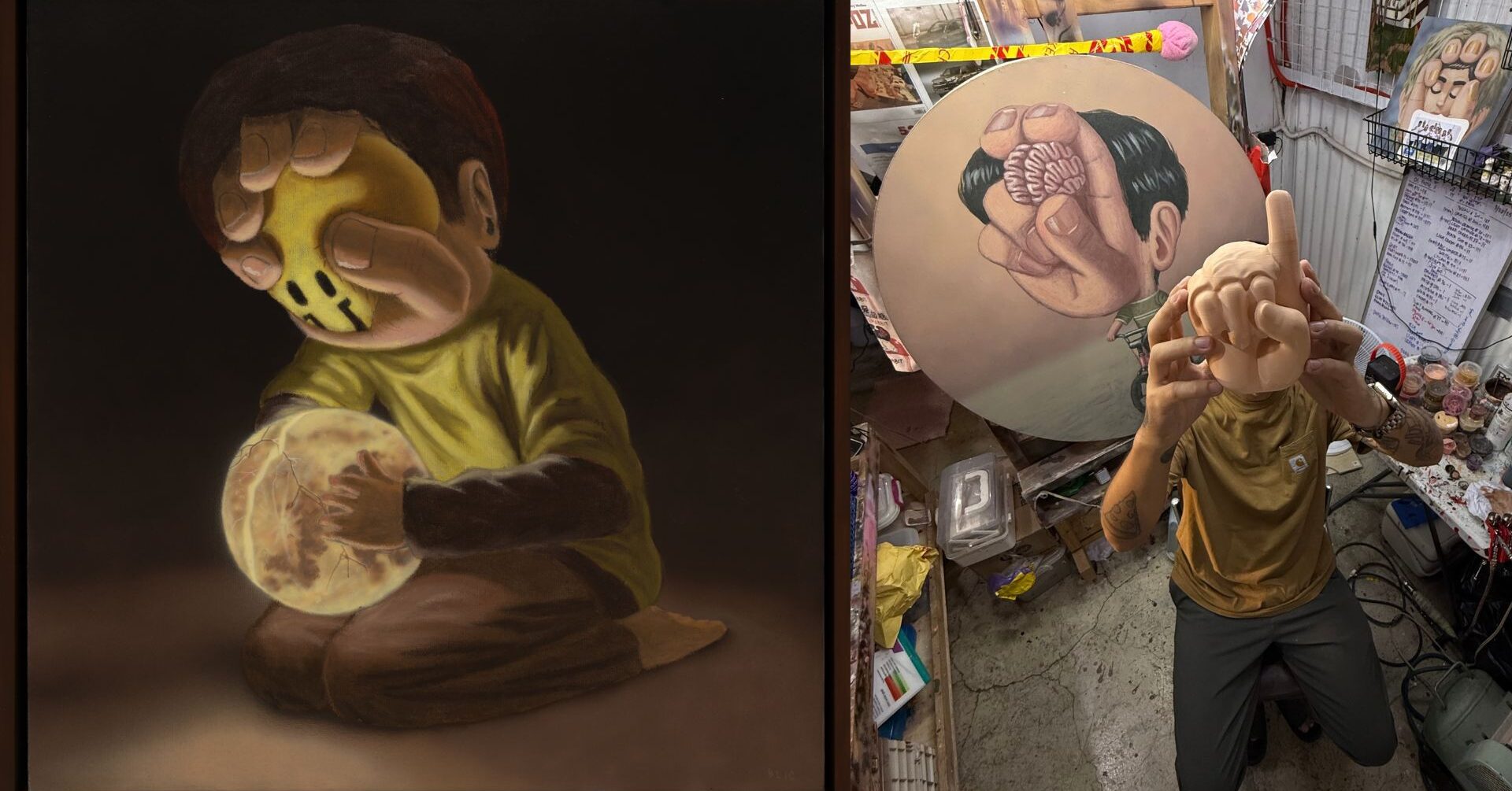
It is a gut feel rooted in his early years on the street, where Blic’s iconography was first nourished by whatever media was within reach. Free from formal institutional training, he absorbed the pervasive visual culture of his upbringing—cartoons, comic books, stickers, and street graphics—translating them into distinct, hand-faced figures that speak to, and oftentimes protest, the travails of the human condition in contemporary life.
How did you find your way into street art?
Street art is a movement. It is community-based, and I found my visual language through my exposure to Pilipinas Street Plan. They welcomed me as a member. They gather artists, teach techniques, at doon ako namulat sa mundo nila.
Mahalaga na i-share natin ang mga nalalaman natin sa community. Movement means na dapat naipapasa ang kaalaman natin sa isa’t isa.
How were you able to develop your visual language as a street artist?
Nanay ko, nagdadala palagi ng “Funny Komiks” galing sa palengke. So ganoong klaseng art talaga ang nag-influence sa akin. Tapos may “Pugad Baboy” pa ni Pol Medina Jr. sa Inquirer dati. Hooked talaga ako sa ganoong mga illustrations.
Pag sumakay ka ng LRT, may mga sticker na makikita sa loob ng train mismo. That was the time of Team Manila and the likes of Dan Matutina, isang graphic design-forward na era sa street culture. Ang daming stickers noon sa LRT at Divisoria, tapos may mga street art mural pa ng PSP sa Carriedo. During this era, I developed one of my early icons: a hollow figure in a hoodie. Eventually, I developed my iconography of human figures with hands in place of faces.
Actually, malaki ‘yong impact sa development ng work ko ‘yong Brown Dada group show nina Bjorn Calleja, Beejay Esber, at Manuel Ocampo sa Vinyl on Vinyl. Napaisip ako sa show nila, na saktong kasabay din ng show ko sa Vinyl on Vinyl. Ang mature ng taste and ng vibe ng show nila. Doon ako nagka-realization na ang “baby” ko pa pala pagdating sa mga trabaho ko as a street artist who also shows in contemporary art galleries.
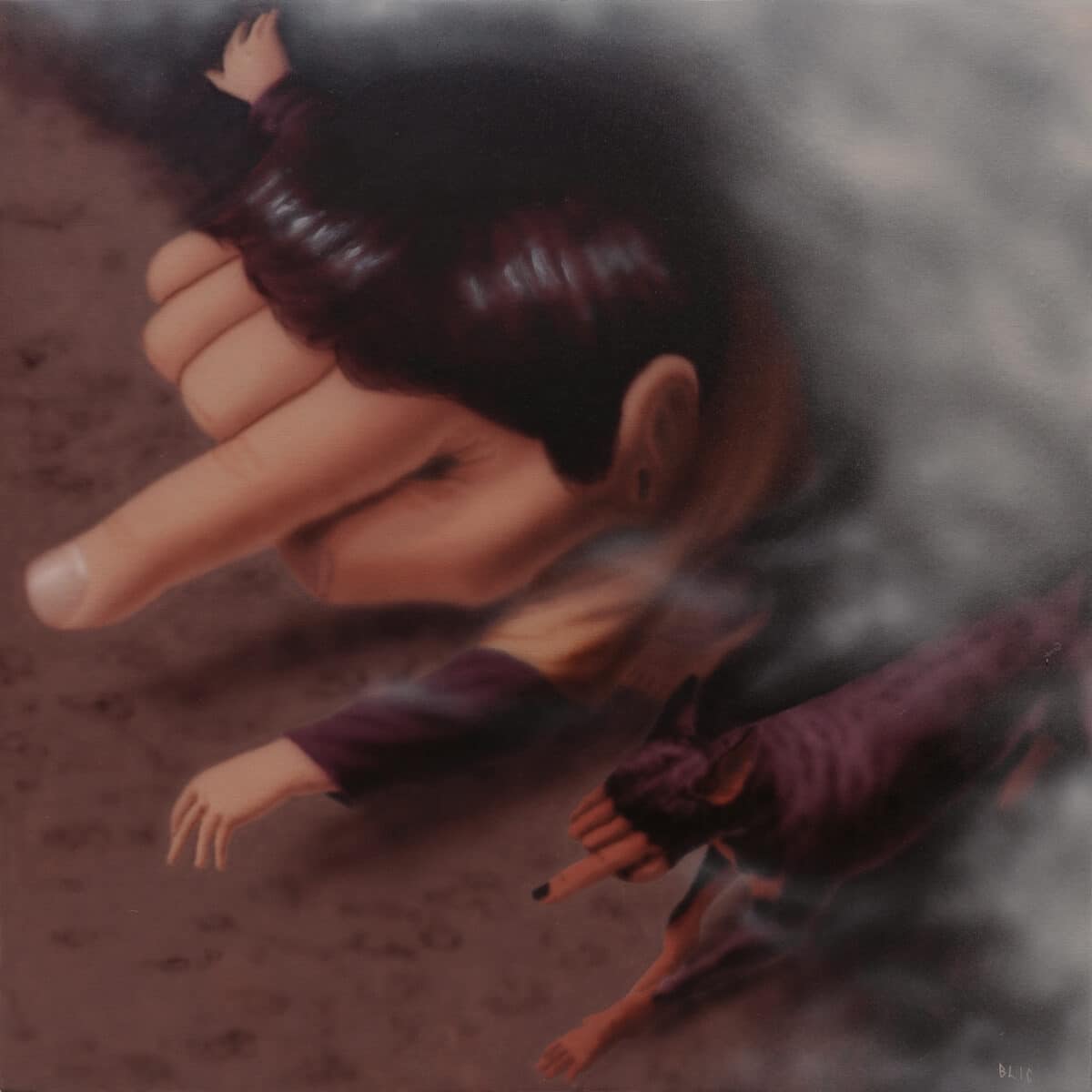
Inspired din ako sa trabaho ni Mark Ryden. Malambot tingnan ang works niya dahil sa handling ng oil. So, ang dami kong artists na tinitingala at pinagkukuhanan ng bagong kaalaman, lalo na kasi self-taught ako.
Hindi rin kasi ako mahilig sumabay sa uso. Medyo matigas din ulo ko. So, nung maraming nag-spray paint, ako naman nag-wheat-paste; no’ng dumami naman ang nag-wheat-paste, nag-large-scale murals using rollers naman ako, tapos nag-cling wrap naman ako.
From there, how did you begin developing your iconic “Taong Kamay”?
Para sa akin, handicap ko ‘yong “Taong Kamay” ko na iconography kasi ang tao na may mukha, mas madali makita ‘ypng facial expressions. Pero ang characters ko kasi walang mukha—kamay ‘yong mukha nila—kaya dapat mas maging klaro ang visual storytelling ko, given my handicap.
I had to give justice to the iconography that I developed. Kaya I used hand signs and symbols sa mga Taong Kamay ko, tulad ng pag-raise ng pointing finger to connote the number one, or raising the middle finger as a form of protest.
What’s the story behind your moniker “Blic”?
My first moniker was very different. It was inspired by the graphic design era in street culture. It sounded very whimsical, and it was quite long—almost like an entire sentence.
READ: 9 artists trace the wild paths of growth in ‘Where Vines Grow Wild’-grow-wild-group-exhibition/
My current moniker, “Blic,” comes from the word “public.” Interestingly, it was another artist who asked me if “Blic” was actually shorthand for “public.” It was a connection that made sense to me, and I eventually embraced it.
Gandang-ganda ako sa nature, but I think I’m even more drawn to urban spaces—eskinita, ghettos, and places like that. Gandang-ganda ako sa texture, character, and even the aroma of these spaces.
What fascinates me most is that their rough and gritty appearance contrasts so heavily with the people who live there, who are some of the kindest and most generous people I’ve ever met. Some of them have even allowed me to paint on the facades of their homes.
Do you think not having a formal art education has been an advantage for you, especially in allowing you to keep pushing boundaries as a street artist?
Naging blessing talaga na hindi ako nag-formal education kasi it taught me to constantly keep learning. Pero noong simula, I saw it as a disadvantage kasi kulang ako sa knowledge about the fundamentals of visual arts. Hindi ako tulad ng mga graduate ng UPCFA, kaya kailangan ko talagang alamin at pag-aralan kung ano ’yong ginagawa ko.

Eventually, I realized that constantly leveling up my game is actually what became a blessing from not having a formal art education. It pushed me to keep learning, experimenting, and challenging myself, which I think has allowed me to continuously push the boundaries of my work, kung paano gumamit ng brush, paano mag-spray, etc. Ayaw ko kasi mapahiya.
How did you get invited by Joyman Gallery to have a solo show with them?
Dorothy Circus Gallery, the gallery that represents me in Rome and London, had a collaboration with Joyman Gallery in Bangkok. That’s how they came to know about my practice. Joyman Gallery in Bangkok is like Vinyl on Vinyl in Manila. Their professionalism is top-notch.
What aspect of Blic did you reveal in your solo show “Hard Shifts” at Joyman Gallery in Bangkok?
Street art is very site-specific, but for my Bangkok show, I chose to focus on universal themes rather than create Bangkok-centric images. I wanted to zero in on human experiences that transcend culture and specific urban spaces.
I wanted to explore the feeling of doubt and the concept of amor fati—the idea of embracing one’s fate and accepting life as it comes. I was interested in how these ideas could resonate with people regardless of where they come from.
READ: Where the window is a cage: Pope Bacay’s ‘What We Hold Sacred’
What was meaningful to me was seeing that connection happen. Russians, a visitor from Laos, and other foreign nationals, including an anthropologist who approached me and told me that “Hard Shifts” resonated with them. It made me realize that even though street art is often rooted in a particular place, the emotions and experiences behind the work can still speak to people across cultures.
What does being featured in Hi-Fructose magazine mean to you?
Even when I was just starting out, my ultimate goal was to be featured on the cover of Juxtapoz Magazine. So being chosen for a full feature in Hi-Fructose, which is one of the biggest magazines for street art and pop surrealism, was something I saw as a significant milestone—not just for me, but, I believe, for Philippine street art as well.
Manuel Ocampo had previously been featured in Juxtapoz, and their presence helped give visibility to Philippine art on an international platform. When I finally saw my full feature in Hi-Fructose, I felt a deep appreciation for the recognition, especially from fellow artists and people within the art community.
Was it life-changing? Perhaps. But honestly, it didn’t feel like it changed anything inside me. I just smiled, appreciated the moment, and went straight back to work.
What can you say about the street art scene in the Philippines today?
To answer that question, I have to first differentiate graffiti from street art. What is booming in the Philippines right now is graffiti, which is a form of writing deeply connected to hip-hop culture. Street art, on the other hand, is a broader movement that seeks to bring art into public spaces and communities that may not have easy access to museums and galleries.
To be honest, I feel that the street art scene is experiencing some stagnation, partly because of how closely graffiti is associated with hip-hop. A lot of what people now refer to as street art is actually graffiti. They are distinct practices, but they are connected in certain ways—more like cousins than siblings.
Why are you an artist?
Kaya ako nandito, kaya ako artist—para maramdaman ng simpleng tao kung gaano kasarap makakita at makadama ng art sa mga public spaces. Gusto kong dalhin ang art sa mga lugar kung saan hindi ito laging naaabot ng ordinaryong tao, at iparamdam sa kanila na ang art ay para sa lahat.