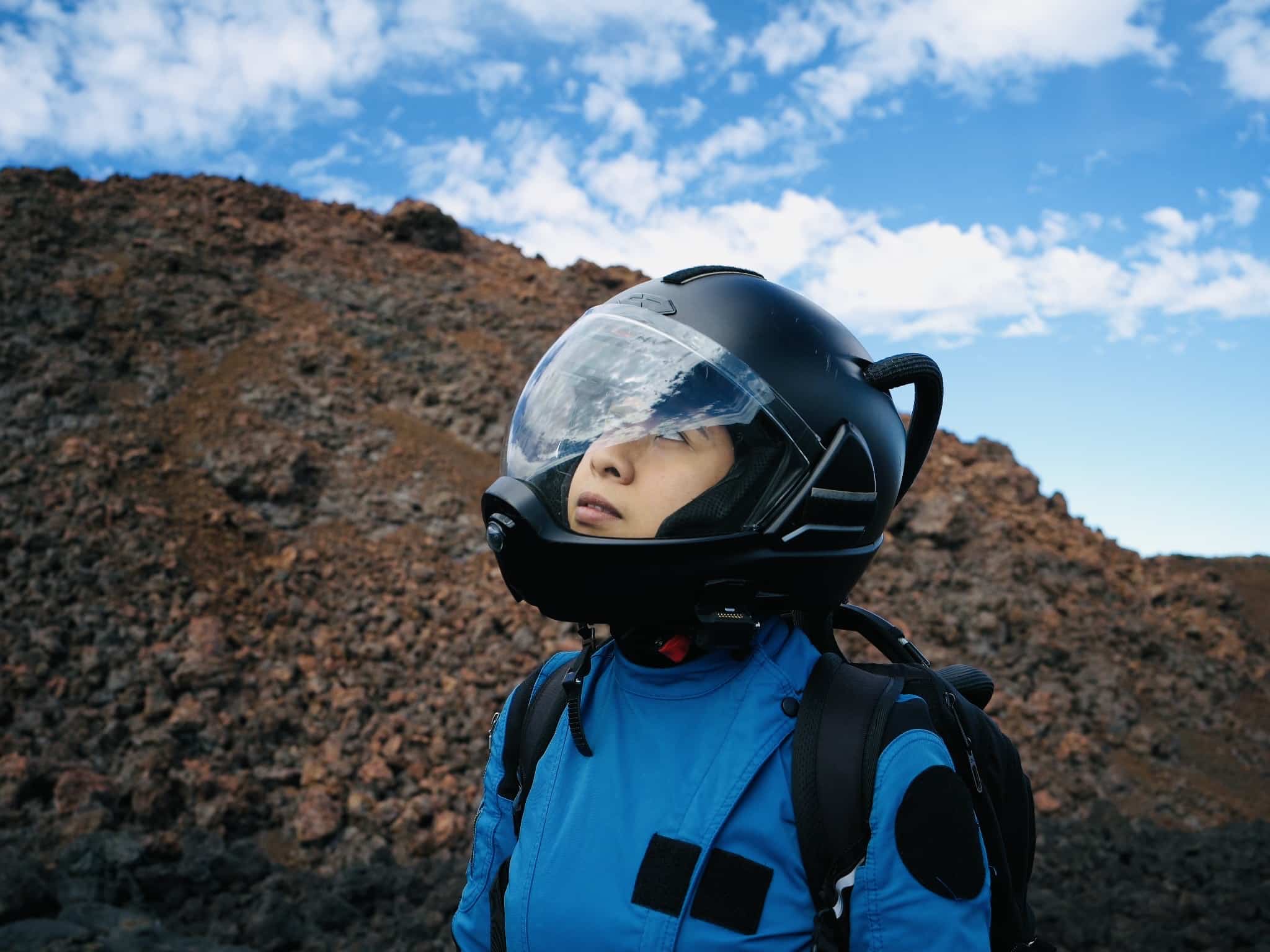
Meet Kristine Atienza: nutritionist, humanitarian, analog astronaut—and mermaid. A self-confessed nerd, Atienza was fascinated with black holes as early as preschool and longed to become an astrophysicist. Not quite self-assured, she eventually shifted and explored other fields, thinking herself not good enough to achieve such a fancy dream.
Instead, she pursued community nutrition at the University of the Philippines Diliman (UPD) as a pre-med course with the intention of becoming a doctor. At one point, she even fancied archaeology. Then came an internship with the United Nations. It was there that she found her vocation.
She eventually realized she could make an impact and be of service to the country. Drawn not only by the science of nutrition but also by its social and economic dimensions, she found herself captivated by public health.
Today, her day job is humanitarian work focused on nutrition. She has worked with organizations such as the National Nutrition Council, World Vision, Action Against Hunger, and the United Nations World Food Programme.
READ: Meet the Filipina who won ‘Top Chef’ season 23

Where space and nutrition collide
Yet while building a career in public health, she never quite lost her fascination with space. After office hours, she volunteered with space organizations alongside fellow nutritionists, scientists, engineers, and enthusiasts from around the world. Through these connections, she learned about analog space missions and eventually became the first Filipino analog astronaut.
(Analog astronauts participate in simulated space missions designed to study what it would be like to live on the Moon or Mars. The missions take place in isolated habitats that mimic many of the physical and psychological challenges of space exploration.)
For Atienza, her worlds of nutrition and space suddenly converged. She first became a researcher for Asclepios in Switzerland, ICEE in Iceland, and LunAres in Poland before eventually becoming a crew member at HI-SEAS in Hawaii, one of the world’s best-known analog space habitats.
Ironically, she thought she would never be accepted. As it turned out, being a nutritionist became one of her greatest strengths. “The mission was focused on food systems in space,” she explains.
The nutritional aspect of space food
Food in space behaves very differently from food on Earth. She quickly debunks the popular image of astronauts surviving solely on dehydrated meals and food squeezed from tubes.
Because yes, real food is served in space. Fresh produce is regularly resupplied, meals are planned with nutritionists and dietitians, and food is packaged for long shelf life and minimal waste. “The closest comparison would probably be an airplane kitchen,” she says.
Proper nutrition is critical for maintaining astronaut health. In microgravity, bone density decreases, muscles weaken, fluids shift toward the head, and even taste perception changes.
That said, many astronauts prefer stronger flavors, making hot sauce a popular condiment in space. “When we’re up in the air, flavor perception already changes,” she explains. “Imagine that, only more extreme.”
Bringing Filipino flavors into space
Atienza pictures bringing Filipino flavors into space. Dried Philippine mangoes. Ube. And of course, adobo—her ultimate goal.
The Pinoy mango project, which she is a consultant for, is already underway through collaborations involving the Philippine Nuclear Research Institute and UPD. She even intimates that ube powder will soon be brought on a LunAres research mission.
Because food, she believes, is one way of leaving a cultural footprint in the cosmos.Atienza points to the recent launch of Asian Cosmic Cuisine during the Asia-Pacific Regional Space Forum as an example of how food can help preserve identity even beyond Earth. “Since we have many vegetable dishes, we can grow them in mission,” she says.
READ: Limited-time food drops to try this June
Life in space (and outside it)

One of her most memorable experiences took place inside the HI-SEAS habitat in Hawaii. Built to simulate life on Mars, the dome-shaped structure contains sleeping quarters, a laboratory, workspace, and kitchen. Water is limited, energy carefully monitored, and there is only one window looking out onto the vast volcanic terrain beyond.
Leaving the habitat requires a scheduled excursion in a spacesuit. But the moment they entered, however, science quickly gave way to a very human concern. “We were hungry,” she quips. The crew then immediately prepared a salad and consumed their fresh produce. And like actual space missions, fresh food is eaten first.
One of her fondest memories was cooking Filipino food for her crewmates. Rice, of course. And pancit.Meanwhile, the most exciting part of the mission were the extra-vehicular activities. Exploring lava tubes while wearing a spacesuit was both thrilling and challenging. “We could barely hear our footsteps,” she recalls.
Simple movements became complicated. Gloves reduced dexterity.
A task that would normally take twenty minutes could easily require two hours. Yet what stayed with her most was the feeling of isolation. “The feeling of isolation in a vast expanse is real,” she reflects. “Considering that I was still on Earth, I can only imagine what the first settlers on Mars or the Moon would feel.”
But the beauty of sunrise during a simulated spacewalks, she said, make everything worthwhile.

Back on Earth
Unfortunately, extended missions are difficult because she still has a day job. Beyond Atienza’s work in nutrition and space exploration, she is passionate about astronomy education.She regularly teaches astronomy to children and believes there is tremendous opportunity for Filipinos in science and space-related fields. “We need more scientists, researchers, and engineers,” she says.
Because for her, astronomy is one of the most accessible gateways into STEM. “Astronomy is magical,” she says. The night sky belongs to everyone. A telescope pointed at the moon. The stars and constellations visible from rural skies… all these are enough to stir the soul and make one curious.
Ultimately, Atienza hopes to help build a stronger space program in the Philippines and contribute to future human spaceflight efforts in Southeast Asia.
She believes a Filipino will reach space within our lifetime. She hopes to be one. More importantly, she sees Filipino children reflected through her journey—wishing they, too, can dream big.
From space damsel to lady of the sea
So how did this space damsel become a lady of the sea? As much as she loved the stars, she was equally enchanted by Disney’s “The Little Mermaid II.”
Years later, she would find a way to fulfill both childhood dreams. Today, she spends part of her free time swimming as a mermaid, gliding through the vastness of the ocean.
Looking back, Kristine remembers the many moments when doubt crept in. Her background. Her nationality. Her gender. The many rejections, disappointments, and setbacks along the way. Still, she refused to let any of them diminish her dreams.
Instead, she chose to let her work speak for itself. She worked harder. She
persisted—with grit and heart. That said, Atienza is proof that when you wish upon the stars, dreams do come true.
SS Meatloaf
Kristine’s favorite recipe from the Astronaut Cookbook
Ingredients
- 2 Tbsp onion soup mix
- 2 Tbsp saltine style crackers, coarsely crushed
- 1/4 tsp coarse ground black pepper
- 1/8 tsp dried oregano leaves
- 1/8 tsp dried basil leaves
- 1 tsp minced garlic
- 2 Tbsp plus 1 tsp Egg Beaters (egg substitute)
- 2 lb lean ground beef
- 1 cup canned crushed tomatoes
- 1/3 cup canned or bottled chili sauce
- 2 Tbsp light brown sugar
- 1/8 tsp distilled white vinegar
Procedures
- Combine the onion soup mix, crackers, black pepper, oregano, and basil and mix well. Add the garlic and egg product and mix well.
- Blend in the ground beef and tomatoes (NASA uses a ribbon blender and refrigerates the mixture overnight).
- Preheat convection oven to 450°F. NASA uses a convection oven, but a conventional oven will work, too.
- Line two baking sheets with aluminum foil and spray with nonstick vegetable cooking spray.
- Scoop out half cup quantities of the meatloaf mixture, form into oval shaped patties, and place on the baking sheets.
- Cook the meatloaf patties for approximately 15 minutes (convection oven), 18 minutes (conventional), or until browned and cooked through. Internal cooking temperature should be 170F to 185F.
- Sauce: Combine the chili sauce, brown sugar, and vinegar and heat.
- Serve the meatloaf and pour the sauce over it.
Yield: 10 servings
Note: NASA further processes the meatloaf by adding the meatloaf and a portion of the sauce to a retort pouch and thermo processing.